Showing posts with label emptiness. Show all posts

Sunday, September 11, 2016

The Three Truths

I was recently in Australia and heard an aboriginal D'harawal people's dreaming story that discussed what are known to them as the Three Truths.  Gawaian Bodkins-Andrews defined the Three Truths as:The Lyrebird, who sought the three truths
  • Midan Yewing:  What you see
  • Barkolo Yewing:  What others see
  • Duragai Yewing:  What is
I find this to be a profound teaching, quite in line with Buddhist teachings on emptiness (shunyata) and nirvana.  We are often captured by what we think we are seeing and then hold it to be the whole truth. We usually go further than this, though, and tell ourselves stories about what is and what has happened, and we make ourselves the hero (or heroic victim) of the story. Yet, what we see is only one part of what is constantly unfolding, and once we label it we take away its vibrancy and vitality. 
Most of us have had the good fortune to realize that what others see can often be very very different from what we saw. If we're lucky, we used those occasions to undermine the certainty of our own position. We probably remained somewhat skeptical that their position was more accurate, because we also have a sense that there is a greater view that could include both views (and other views of which we aren't yet aware). That is, we sense that "what is" must be bigger than our limited views.
What I find to be so profound is that this teaching calls all three of these viewpoints "truths."  What you see, even though it's deeply limited, is still your truth.  What others see is their truth. What is is still another truth.  This teaching does not say that only what is can be the Truth.  This is similar to how Buddhism considers both relative and absolute truths. Absolute truth isn't more "true" than relative truth, even when they may appear to conflict. One goal of training is to learn to hold more than one truth at a time, and to be skeptical of all of our interpretations of them. This is why some Buddhist practices focus on keeping "Don't Know" Mind. Can we remember in each moment that there are more truths than ours, and none of them is as all-encompassing as What Is?

Image source: https://upload.wikimedia.org/wikipedia/commons/0/04/Menura_superba_-_Thomas_Davies.jpg

Thursday, June 18, 2015

Why every experience you have is 99% wrong

I sat outside on a lovely early summer morning. The sun played hide-and-seek with the clouds, who in turn were playing chase with the breezes. The garden had turned a rich green from the recent rains, and the strawberry flowers whispered of treats to come in a couple of weeks.  I set my meditation timer for 24 minutes, and set an intention to be aware of the arising and passing of sensations.

As the sun came out, I felt my skin warm.  As the breeze played tag, I felt my skin cool. Birds of many types sang from unseen places, although sometimes they passed before my eyes. A male and female cardinal eyed me suspiciously as they considered the bird feeder nearby. Their suspicion proved well-founded once they realized there was nothing in it.  The sound of cars arose and passed. I tasted my coffee, and savored the bitterness tempered by the teaspoon of sugar I had added. I noticed the heat of the coffee through the cup, and also saw the feeling of dislike arise as the heat felt like a threat.  I quickly put the cup down, but later picked it up again just trying to feel the arising of heat without judging it as aversive. I watched my thoughts sometimes follow my experiences, and sometimes lead them.

Perhaps this sounds like a "good" meditation session. What surprised me was the thing I called "my experience."  I was aware of each of these aspects of life's flow around and within me.  How disappointing.  I was aware of each of them.  One.  At.  A.  Time.

This thing we call our experience is only a tiny slice of what we are actually experiencing.  When noticing the breeze upon my skin, I wasn't also noticing the birds or the color of the grass.  In fact, I wasn't even noticing the breeze upon my skin - I only noticed it on certain parts of my skin where I focused my attention.  I was actually feeling it on my whole body, but only attended to how it cooled my legs or chest. Once it passed, I noticed the sound of some bird, but just that one - not all the other sounds, such as the wind in the trees, the myriad birds farther away, the sound of my heart beating, or the strawberries flowering. Tasting my coffee clouded all awareness of sights, sounds, feelings. Yet, all of these experiences were occurring at once.  Why do we believe experience is singular?

Attention is like a spotlight - it can focus on only one thing at a time. Worse still, it's a very narrow beam of light.  It can pick up only about 1% of what is happening at any given moment. To put it another way, that means that our understanding of what is occurring at any moment is 99% wrong! And still we persist in the belief that we are always right and know what's going on.

How would it be if we could truly experience the emptiness and multiplicity of experience, without the constant narrowing, labeling, and solidifying?

Wednesday, July 17, 2013

What Do You Mean, "You're Welcome?"


I was recently in France and Spain, trying pathetically to at least speak the bare minimum of niceties in each country’s language.  This brought me face-to-face with some of the differences in phrasing, and potentially some differences in meaning.  In America, we’ve all been taught to say “You’re welcome” when someone thanks us for something.  In fact, most of us have learned this polite response so well that it’s almost a nervous tic.  We say it automatically, with little thought other than perhaps a vague feeling that we should say it.  Yet, it is a surprisingly remarkable phrase, especially when contrasted with the equivalent phrase in other languages. 

Buddhism teaches us to examine the routine aspects of our experience, especially those we do habitually or automatically.  It also teaches us that our intentions matter, which become especially interesting to consider for habitual responses.  Do they even have an intention once they’ve become automatic?

When we say “you’re welcome,” it can be perfunctory, with no intention and little attention, other than to complete a ritual or to be perceived as gracious and polite.  Yet at its core, this is a profound statement of intention.

In many other languages the corresponding phrase is dismissive.  “De nada” in Spanish, “Ne rien” in French, “Nincs mit” in Hungarian, “Bú kèqi” in Chinese, and even “No worries” in Australian all basically mean “It’s nothing, don’t mention it, it’s no problem.”  This approach can certainly be gracious, but it also seems like it could be taken as not paying attention.  It ignores what might have taken genuine effort - It doesn’t acknowledge intent.

In contrast, “you’re welcome” demonstrates intent.  It offers the other person freedom to act.  If I welcome you to my home, I am setting you free in it. I am giving you access, and am not guarding or protecting or clinging to it.  This seems to me to be a profound intent to let go, to allow, and to honor the other beings.  It doesn’t cling to the idea of a certain outcome.  In this way, “you’re welcome” seems very different from “It’s nothing.”  Although we often say it with very little intention, we could change that.  With a small amount of effort, we can pay attention to this little letting go with compassionate intent.

Examining the differences between these meanings, however, is only one approach to consider.  How are these ways of saying it similar?  They all seem to demonstrate an understanding of emptiness (shunyata) and non-self.
De nada.  It’s nothing.  I see the gap.  There is no necessary action required.  There is no outcome needed.  There is nothing to cling to (even if I have an intention of lovingkindness).


No matter which phrase we use, it expresses an openness to whatever is occurring and will occur, without worrying about what I need to do next.  I am not feeling indebted to you, nor do I expect something from you.  When we say “it’s nothing,” “no problem,” “you’re welcome,” can we see the emptiness we’re pointing toward?  Can we have the intention to allow the moment to unfold without our control, trusting in the inherent fecundity of the emptiness?

(This article was first published on the Interdependence Project Blog.  Image sources not by the author are here and here.)

Sunday, April 21, 2013

Working with Anger (and other Strong Emotions)

On the American Buddhists group on the Insight Timer app, a question came up about dealing with strong emotions.  In particular, this colleague asked,  "How do I apply the peace of mind I feel while meditating when I finish my session?  I have anger issues."


There's obviously not one single answer nor is there a simple answer (well, there is - it's practice and time, but that's not a very satisfactory answer at the moment you're feeling the anger). 

In the Buddhist view, emotions have two properties that are co-emergent - wisdom and confusion. That is, when you are feeling an emotion, there is an aspect of wisdom behind it. With anger, it's usually the recognition that something isn't right. The problem is that co-emerging with the wisdom is also ignorance/confusion/clinging - we feel the anger and then (1) believe we have to DO something because of it, (2) believe that our story about it is somehow "real," and (3) our clarity of thinking often gets impaired, so we act unskillfully. So when you are seized by anger, can you separate the wisdom part out from the ignorance part? Can you allow yourself to feel it but not feel the need to act, at least until you've considered what would be a skillful action?

Another way of thinking about using what you find in meditation in the moment may be to focus on the gaps. This is kind of hard to explain in words, especially if you haven't really noticed it in your practice yet, but one thing many people notice in their mindfulness meditation is that there are actually spaces between thoughts, feelings, and impulses to act. In our normal lives we usually just let them run together so that they not only feel continuous, but they feel causal - you said that which caused me to feel this which caused me to say that. But in truth, there can be a gap between all of these parts. Can you find it in the moment? Focusing on that gap can greatly lessen the intensity with which you feel the anger, or can lessen the intensity with which you feel you must react to the feeling or the other person.

These are not the only approaches one could take (e.g., you could try to find compassion for the person annoying you, but I think that's really not realistic for someone struggling with anger issues). You also might want to stop trying to achieve peacefulness in your meditations, and instead begin to do mindfulness of feelings, seeing where anger comes from and where it goes. If you're only using meditation to try to achieve a special state (i.e., peace of mind), then you're not getting everything out of it that you could.  In a sense, meditation doesn't really get "rid" of anything we feel, but it can help us to not be so caught by the feelings that we feel trapped into a habitual pattern.

There's a Lojong slogan that is sometimes translated as "Don't be so trustworthy."  I like this because it encapsulates very simply how we are such creatures of habit.  Something triggers our anger, and we already know how we're going to feel, how we're going to react, and what will come of that - it has a feeling of destiny like a rushing freight train.  This is especially true in our relationships, where we've often spent many years practicing the patterns.  That may be where the real fight is with your anger issues -- there is a habitual trigger and a habitual response.  These conditioned states are the hardest to break, and yet they're so central to our peace (or lack of it).  So the slogan is meant to help us realize that there is a gap between trigger and response, and we don't have to be so trustworthy - don't do what you and everyone else expects you to do.  Do something different.  Maybe it will turn out badly, but maybe it will just be surprising enough to derail the rushing train of habitual events, or at least push it onto a new track to see where that goes.

Ultimately, this isn't the path just for anger issues, but for all of our habitual emotional reactions that keep us stuck in bad patterns (the kleshas).

Saturday, February 23, 2013

Princess Leia and the Buddha

"All created things are impermanent."
Seeing this with insight,
One becomes disenchanted with suffering.
The Dhammapada (277, translated by Gil Fronsdal)

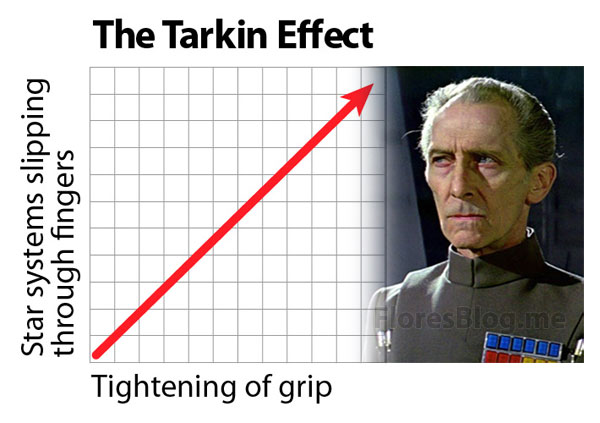
Groundlessness is a really interesting concept.  Although we know its truth, we ignore and resist it.  That is, we know from our own experience that everything changes, and that trying harder to seek solidity only causes more anxiety and stress.  The great philosopher Princess Leia once described it thus:
"The more you tighten your grip, Tarkin, the more star systems will slip through your fingers."
Princess Leia to Grand Moff Tarkin
We work very hard to try to get some ground underneath us and we fear uncertainty.  It's unclear to me why this is, however.  Almost everyone already has at least two clear insights.  First, we know that we become more anxious when we worry about things changing, and we produce more suffering when we try to hold on tighter.  Many people have seen this in romantic relationships - as one partner becomes clingier and tries to hold on tighter, it causes both people distress and ultimately damages the relationship.  Second, we know that we don't really know what will happen, and many times that's the most fun.  For example, I am planning a trip to France with my daughter - we have never been, and she is super excited because she doesn't know what it will be like.

We therefore know from our own experience that trying to hold onto certainty is distressing and that uncertainty can be pleasant.  So why do we fight it so much?

One reason is that this is, of course, an oversimplification.  Solidity can also be fun (at least for a while) and uncertainty can also be distressing.  Perhaps what we fear isn't really the uncertainty per se.  Perhaps what we really fear is the emotions we have to open ourselves to when we don't know what to expect.  This is why some people seem to be much more content to be unhappy all the time, holding on to a limited world view that everything sucks.  At least with this approach they can know what to expect and are rarely disappointed.  They have not yet become "disenchanted with suffering," and they work hard to make the ground of their lives as solid as possible.

The irony of this approach is that even the ground is not stable.  Even if you were to sit as still as possible on the cement, the earth is spinning at about 1,038 miles per hour, and the earth is moving around the sun at 67,108 mph, and our solar system is moving around the galaxy at about 514,000 mph, and the galaxy is moving around the local galactic cluster at about 89,000 mph, and the local cluster is moving around the local supercluster at about 1,342,000 mph.  That means that sitting completely still, you are still moving at about 2 million miles per hour.  Furthermore, the ground itself is groundless...it is constantly changing in shape and constitution based on changing temperatures, weather, use, friction, decay, etc.

What if we stepped into the stream of uncertainty without resistance?  Pema Chodron says, "Something about 'nothing solid' begins to equal freedom....This moving away from comfort and security, this stepping out into what is unknown, uncharted, and shaky -- that's called liberation" (Comfortable with Uncertainty, pp. 43-44).  Ralph Waldo Emerson put it this way:
"People wish to be settled.  Only as far as they are unsettled is there any hope for them."

Sunday, February 17, 2013

Ernest Hemmingway and Emptiness (Shunyata)

In 1933, Ernest Hemmingway wrote a three-page short story, titled A Clean, Well-Lighted Place.  It's a masterpiece of writing technique, and valuable for study simply for that.  But for such a short piece, it is a profound description of the human condition as it relates to the Buddhist concept of Śūnyatā, which is often translated as emptiness or nothingness.

Westerners often become acquainted with this when hearing how Buddhists talk about non-self or egolessness.  This is a difficult concept, and it usually gets misinterpreted in one of at least two ways.  It can sound like Buddhists think you don't actually exist, or that Buddhism is nihilistic and that there is no meaning to anything.  This is incorrect.  Buddhism does not deny that you or anything else exists, but instead that everything exists dependently on everything else and is constantly changing - so there isn't a solid "thing" that is you.  You are different in each new situation and with each passing moment.  Furthermore, this understanding makes it clear that everything is actually much more meaningful than we usually realize.  If we are interconnected with everything else, then our actions matter for more than just ourselves.

Nonetheless, it is definitely disconcerting when you stare this truth in the face.  Realizing that everything you think you are is not accurate, that there is nothing solid and unchanging, and that there is nothing about you that is really "you" can be terrifying.  What happens when you come face to face with this nothingness?  Hemmingway describes three paths.  I recommend reading the story right now by clicking here.

There are three characters, the old man customer, the young waiter, and the old waiter.  Each has a different approach to dealing with the inherent emptiness of existence.

The Old Man

"Last week he tried to commit suicide," one waiter said.
"Why?"
"He was in despair."
"What about?"
"Nothing."
Facing the inherent instability of existence, what Pema Chodron often calls "groundlessness," the "fundamental ambiguity," or sometimes the "fundamental anxiety of being human," is scary.  I had a student who could easily be reduced to a terrified puddle of nonfunctionality any time she considered the fragility of her existence.  Indeed, there are whole branches of psychology (e.g., Terror Management Theory) devoted to describing this fear and our reaction to it.   The old man typifies one reaction - he despairs.
"He's drunk now," he said.
"He's drunk every night."
The old man tries to numb himself to the nothingness, and when even that doesn't work, he leaps into it trying to annihilate himself.

The Young Waiter

"I wish he would go home.  I never get to bed before three o'clock. What kind of hour is that to go to bed?"
"He stays up because he likes it."
"He's lonely.  I'm not lonely.  I have a wife waiting in bed for me."
The young waiter exemplifies another typical response - he works harder to hold onto his selfish point of view.  He clings to the perception that his way of seeing things is right and others are the selfish ones.

"I wouldn't want to be that old. An old man is a nasty thing."
"Not always.  This old man is clean.  He drinks without spilling.  Even now, drunk.  Look at him."
"I don't want to look at him.  I wish he would go home.  He has no regard for those who must work."
He refuses to look at truth.  Although the young waiter will get old like the customer, he wants instead only to rush off, distracting himself constantly and believing that his point of view is solid.  When confronted with the difficulties of life, compassion, and uncertainty, he rejects them and cloaks himself in confidence.
"No," the waiter who was in a hurry said, rising from pulling down the metal shutters. "I have confidence. I am all confidence."
The young waiter is a personification of Avidyā, or ignorance. Traditionally, this is one of the "three poisons," and is taken to mean a fundamental misunderstanding of the self as separate and solid. This is the not-knowing aspect of ignorance. The young waiter also demonstrates another aspect, however - the ignoring aspect of ignorance. He clings to his perceptions and actively ignores seeing anything else.

The Old Waiter

"I am of those who like to stay late at the café," the older waiter said. "With all those who do not want to go to bed. With all those who need a light for the night."
"I want to go home and into bed."
"We are of two different kinds," the older waiter said. He was now dressed to go home. "it is not only a question of youth and confidence although those things are very beautiful. Each night I am reluctant to close up because there may be some one who needs the café."
The old waiter demonstrates a more mature and wise approach. He does not deny the fear that comes with the fundamental groundlessness of existence - indeed, he feels it deeply.
What did he fear? It was not a fear or dread. It was a nothing that he knew too well. It was all a nothing and a man was a nothing too. It was only that and light was all it needed and a certain cleanness and order. Some lived in it and never felt it but he knew it was all nada y pues nada y nada y pues nada. Our nada who art in nada, nada be thy name...
This is perhaps a type of right view - seeing things as they are. There is nothing to hold on to, and there is nothing outside ourselves that can fix that. Nonetheless, shining a light on it helps - in contrast to ignoring it or masking it with external stimulation and diversion ("Certainly you do not want music.") You want to stand before it with dignity, and when you do you see that it is not as scary as it first seems. In fact, it has a type of orderliness to it that can be reassuring. Some of the fear comes from the words we use - we focus on words like emptiness, nothingness, and groundlessness. Instead, we could just as easily say "freedom." Because we are not solid, we have much more freedom to act, react, and feel than we usually believe.
He disliked bars and bodegas. A clean, well-lighted café was a very different thing. Now, without thinking further, he would go home to his room. He would lie in the bed and finally, with daylight, he would go to sleep. After all, he said to himself, it's probably only insomnia. Many must have it.
The old waiter still feels the anxiety. He cannot sleep in the dark. But he also recognizes that he is not alone - many must have this fear. For me, here is the heart of this parable. The old waiter not only can accept his own anxiety, but he has compassion for all others and the ways in which they deal with it, and he is willing to stay open later at night in case there is one whom he can help. This is the bodhisattva ideal - that as we achieve enlightenment, we remain open to help others who can benefit from it.