Showing posts with label meditation. Show all posts

Monday, December 4, 2017

Anxiety - Who can help you out of this mess?

Modern life is anxiety-ridden.  A surprising number of my students have diagnosed anxiety disorders.  Things don’t always go our way, and often it feels like they never do.  We spend inordinate amounts of time planning and strategizing to try to get things just as we want them, only to have the balance upset easily.  I have a friend who has caring parents, went to a good private school through high school, went to a good college, got good grades, got into graduate school, successfully received masters and Ph.D. degrees, and now has a job teaching college, which is what she always said she wanted.  Yet daily she complains bitterly about how she has it so much tougher than everyone else and never gets a break.  If you try to point out that things are really pretty good, her response is how you “just don’t understand.”  I wish I could say that this view of the world was unique to her, but I hear it from both of my equally privileged teenage daughters, I hear it on reality TV shows, and I hear it from presidential candidates. I believe I even heard it come out of my mouth during my miserable divorce.  So this seems to be “the Human Condition.”
But does it have to be?
If we examine what is underneath the complaining, self-pity, blaming, and anxiety, it’s the truth of dukkha.  We don’t get what we want.  We get what we don’t want.  We get what we want only to lose it.  We don’t feel the way we want to.  Want want want.  Get, don’t get – it doesn’t matter.  We are discontent soon, no matter what the external circumstances.  This is good news
If we are discontent no matter what the external circumstances, why do we keep believing that the solution is something external? Pema Chödrön says you can always ask yourself “Have I felt this before?  Have I done this before?”  If the answer to either of these questions is “yes,” then it’s a clue that it’s time to try something different.
This is not new.  In 1930, Bertrand Russell wrote:
We are all familiar with the type of person, man or woman, who, according to his own account, is perpetually the victim of ingratitude, unkindness, and treachery.  People of this kind are often extraordinarily plausible, and secure warm sympathy from those who have not known them long. There is, as a rule, nothing inherently improbable about each separate story that they relate. The kind of ill-treatment of which they complain does undoubtedly occur.  What in the end rouses the hearer’s suspicions is the multiplicity of villains it has been the sufferer’s ill fortune to meet with.  In accordance with the doctrine of probability, different people living in a given society are likely in the course of their lives to meet with about the same amount of bad treatment.  If one person in a given set receives, according to his own account, universal ill-treatment, the likelihood is that the cause lies in himself, and that he either imagines injuries from which in fact he has not suffered, or unconsciously behaves in such a way as to arouse uncontrollable irritation. (The Conquest of Happiness, pp. 89-90)
From a Buddhist point of view, this conclusion is much too harsh.  The perpetual victim is not particularly different from anyone else – he just makes the same mistake we do more often.  What is the mistake?  It is ignorance of at least six types.  First, we don’t see the multiple causes and conditions of our situation, so it looks like things just “happen to” us.  Second, we see ourselves as separate from the situation, rather than an integral part of the situation.  Third, we see the situation as a series of endpoints, rather than an ongoing organic process. Fourth, we maintain the illusion that we should have more control over our experiences than is actually possible. Fifth, we try to hold ourselves apart from our experiences, as if we need to constantly be defensive, perhaps because we secretly know we can’t control life. Finally, we prefer to blame the situation and others so that we have an overly simplistic story to tell ourselves and others.
There isn’t anything terribly wrong with this pattern, other than that it will continually repeat.  Some people seem so enamored of their stories of suffering that they actively resist doing anything that might truly make themselves happier.  That would be much scarier than continuing to fail and be able to blame others for the failures.
Does this resonate for you?  You aren't actually stuck.  There is tremendous freedom available to you in this next moment.

Monday, February 23, 2015

Singing the Song of Being

Beginning a mindfulness meditation practice is difficult.

You worry whether you’re doing it right.  You want to know what you’re getting into, but it’s hard to know what the benefits will be.  It is hard to know whether it’s worth the effort.  It often isn’t as relaxing as you imagined.  It’s hard to know how your path through the practice will be similar to anyone else’s.  It is perhaps because of these difficulties that many of the classical Buddhist teachings are in the form of similes, stories, and metaphors.  We can’t tell you exactly what will work for you or how to go about it, but we can hint at it.

One arm of the Eightfold Path that is particularly difficult to describe clearly is the one about Right Effort.  How much and what kind of effort is “right?” (I tend to prefer the terms “skillful” or “appropriate” rather than "right.")  The answer to this depends partly on your intended goal and the path you want to take to achieve it.  The classic story about skillful effort is from the Sona Sutta, about a monk named Sona who was trying too hard to achieve enlightenment.


According to the story, Sona had been practicing walking meditation so hard that his feet were bleeding and he became despondent and considered giving up his life as a monk.  To paraphrase, the Buddha knew that Sona had been a skilled vina player prior to being a monk (a vina or veena is an ancient Indian stringed instrument that is played by plucking it).  Buddha asked him, “when the strings of your vina were too taut, was your vina in tune and playable?" to which Sona answered “No.”  Buddha then asked him, “When the strings of your vina were too loose, was your vina in tune and playable?" to which Sona answered again “No.”  Buddha concluded by saying that in the same way, when we hold our minds too tightly we become restless, and when we hold them too loosely we become lazy.

Although this part of the story is fairly well-known, the sutra continues at some length.  Apparently this instruction was beneficial for Sona, because he figured out the right amount of effort and achieved enlightenment.  From this point on, however, the sutra gets weird (my opinion only).

Sona seeks out the Buddha apparently to show off how enlightened he is, and seems to brag about his achieving liberation and his dedication to only six things: “renunciation, seclusion, non-afflictiveness, the ending of craving, the ending of clinging/sustenance, and non-deludedness.” He continues by saying that having achieved this imperturbability, when his experience includes powerful forms, sounds, smells, tastes, feelings, and ideas, “his mind is neither overpowered nor even engaged” [emphasis added].

What strikes me as odd is that I doubt that these are the goals most modern American Buddhists have.  Some of them sound great – I’m all for ending ignorance/confusion, not being afflicted, and not being driven by cravings.  I even like the idea of being imperturbable when things get nutty.  Nonetheless, I don’t really want to be secluded from others or disengaged from my life and the powerful experiences that occur. I want to be deeply involved and moved by my experiences, without being controlled by them.

Perhaps this sutra is designed to be a model for those entering the priesthood and not for householders.  Perhaps it has lost (or gained) something in the translation.  Perhaps I am simply misunderstanding its deeper meaning, but maybe there’s another way to consider this story without it seeming so stark.
  
Instead of simply asking the question about what allows the string to be in tune and playable, what if we asked the question about how we can make music?  Even once the string is tuned properly there is no music.  If we simply hold the string we get no music.  If we space out and pay attention to something else we get no music.  It is only by a process of placing and releasing our fingers on the strings that they make a sound, and we must return constantly to the strings to play the next notes of the melody.  In a like manner, if we try to hold our minds or our breath too steadily, we are not allowing ourselves to breathe and feel naturally – to sing the song of our being.  If we space out and chase our thoughts, we similarly are not fully engaged in our lives.  It is only by constantly lightly touching our experience with awareness and returning it to mindfulness that we feel and sing the living song of our being.

Picture sources: Here and here.

Monday, November 3, 2014

Were you free to make a choice you didn't know you had? Where free will begins.

In a previous post, I asked you to consider the example of someone insulting or offending us, we get angry and immediately think of things we would like to say or do in response.  What would our motivation be for saying or doing any of them? Although you could spin it in several directions, such as to clarify the others’ mistake, to defend yourself, to get back at him/her, to put the other in his place, to just hit him, etc., they actually have one thing in common – they are motivated by the feeling that they will make you happier if you do it. 

Now here’s the funny thing – if you were to examine the motivation behind why the other person said or did whatever it was that he did, it’s exactly the same reason.  He thought it would make him happier.  In this respect, you two are always on the same wavelength. So one way to work with the negative feelings is to recognize that there is no fundamental difference between either of your perspectives. The problem is that our perspective usually does not include the other’s perspective. 

Humans suck at seeing another’s perspective.  There are many reasons for it, but a lot of it is just how the human brain works.  There is a cognitive bias that is so basic to all human thought that it is called the Fundamental Attribution Error.  When someone does something, especially something annoying, we tend to attribute the causes to something internal and/or essential about that person - he is just a jerk. In contrast, when we do something that could be annoying, however, we tend to attribute the causes to external situations.  We had no other choice, or we're in a hurry.

It's interesting to note that to ourselves, we always have a “good” reason for why we are doing whatever selfish thing it is we’re doing.

The corollary to the fundamental attribution error is what might be called the fundamental self error – that we relate everything to ourselves as if everything is a personal affront or benefit. The other part of a fundamental self error is that we believe there is a fundamental self – something unchanging at the core that things happen to. If we’re a stable permanent thing, then any changes that occur are from the outside happening TO us. We get to pretend constantly that we’re the victim, even of our own feelings. For example, how often have you said, “That thing you did MADE me mad,” or “I fell in love with you because you’re so sweet?" We interpret even our own feelings as something that happened to us because of external circumstances.

The irony is that we take no responsibility for our own actions and reactions, but we call this freedom.

Wouldn’t true freedom be the ability to not feel controlled by the situations and our emotional reactions? Wouldn’t true freedom be the ability to see all the perspectives?  If we believe that free will is the ability to make our own choices, when our perspective is so narrow that we can’t even understand the choices available to us, how can we have any free will? Were you free to make a choice that you didn’t even know you had?

Psychologist Roy Baumeister said, “Self-control counts as a kind of freedom because it begins with not acting on every impulse. The simple brain acts whenever something triggers a response: A hungry creature sees food and eats it. The most recently evolved parts of the human brain have an extensive mechanism for overriding those impulses, which enables us to reject food when we’re hungry, whether it’s because we’re dieting, vegetarian, keeping kosher, or mistrustful of the food.” 

So freedom begins when we STOP acting, or at least slow down the reacting. This is also the first step to being open to seeing other perspectives.  As long as we continue to act in our habitual ways, getting into the same arguments over and over again, continuing to believe that we're right, we will never be free.

This is where meditation can be such valuable training. One technique that can help us begin to slow the automatic processes of reacting down is called Urge Surfing, which can be read about here and there is a nice short guided example available here.


Image sources: Here and here.

Friday, February 14, 2014

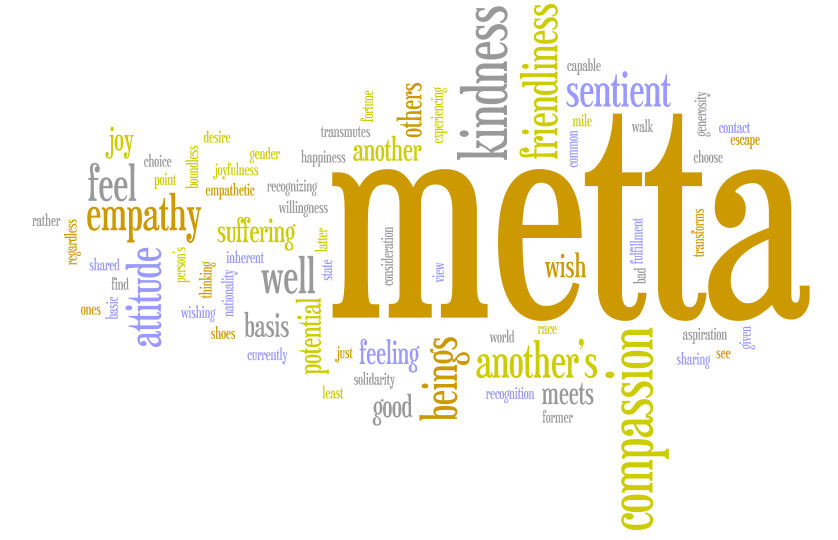
The Brahmaviharas: Loving-Kindness

The idea of cultivating loving-kindness through meditation is one of the ideas that people generally like. Despite its positive connotations, however, it may be useful to consider the darker side that it combats.

The original Pali word metta can be translated into English in many ways, such as loving-kindness, friendliness, good will, benevolence, fellowship, amity, inoffensiveness, and non-violence. It is a wish for the welfare and happiness of others, without the self-interest that is often subtly underneath our friendly behaviors.

As ideal as this sounds, Buddhist practices are not meant to be theoretical - they are meant to be practical. They are designed to achieve specific goals. The Brahmavihara practices are designed to help us alleviate our suffering, which coincidentally alleviates others' suffering. Metta practice is designed (in part) as an antidote to anger. Why, however, should we care about lessening anger? Culturally, we're told that anger is good (at least for men) - it makes us strong.

The Buddha stated that when you are angry, there are seven things that are gratifying and helpful to your enemy.  The seven, in abbreviated form, are:
  1. An enemy wishes for his enemy, Let him be ugly.  Anger makes us ugly.
  2. An enemy also wishes, Let him lie in pain.  No enemy relishes your lying in comfort.
  3. An enemy wishes, Let him have no prosperity.  When you are ruled by and prey to anger, you mistake good for bad and bad for good.  Thus, mistakes are made that harm you.
  4. An enemy wishes, Let him not be rich.  When angry, though you may have built up riches by the strength of your arm, earned by sweat, lawfully gained, yet the king’s treasure gains through fines due to your being prey to anger.
  5. An enemy wishes, Let him not be famous.  Yet, when ruled by anger, what fame you may have acquired by diligence is lost through being prey to anger.
  6. An enemy wishes, Let him have no friends.  When ruled by anger, the friends you do have, companions, and even relatives will keep away  from (or even be harmed by) your anger
  7. An enemy wishes, Let him suffer death and hell afterwards.  When angry, prey to anger, ruled by anger, a person misconducts himself in body, speech, and mind, and by this misconduct, reappears in a state of deprivation, in a bad destination, in perdition, even in hell, through his being prey to anger.

For more details, read The Practice of Loving Kindness  

The underlying psychology behind the Brahmavihara practices are that if we can change our minds, then we can have more peace both for ourselves and for others. Metta is the antidote for anger, annoyance, and hatred. The Buddha himself listed 11 benefits of cultivating metta:
"Monks, for one whose awareness-release through good will is cultivated, developed, pursued, handed the reins and taken as a basis, given a grounding, steadied, consolidated, and well-undertaken, eleven benefits can be expected. Which eleven?
"One sleeps easily, wakes easily, dreams no evil dreams. One is dear to human beings, dear to non-human beings. The devas protect one. Neither fire, poison, nor weapons can touch one. One's mind gains concentration quickly. One's complexion is bright. One dies unconfused and — if penetrating no higher — is headed for the Brahma worlds."
 It is worth examining the sutra where the Buddha taught metta practice in some detail. There is, of course, a mythological story that goes along with it (adapted from here):
500 monks received individual instructions from the Buddha, and went to the Himalayan foothills to spend a four-month rainy season retreat living in intensive meditation.  According to the commentary by Buddhaghosa, it “appeared like a glittering blue quartz crystal: it was embellished with a cool, dense, green forest grove and a stretch of ground strewn with sand, resembling a pearl net or a silver sheet, and was furnished with a clean spring of cool water.”  The monks were captivated.  There were also some towns and markets nearby, where they could beg for alms. 
The residents apparently were pleased the monks were here, and offered to build each a hut near the grove so that they could spend their days under the ancient boughs of the majestic trees.  After settling down contentedly into these huts, each monk selected a tree to meditate under by day and night.  It was said that these great trees were inhabited by tree-deities who had celestial mansions with the trees as the base.  The deities did not like to remain above them, so stayed away, assuming the monks wouldn’t stay long.  But after several days, the deities decided to try to scare the monks away by showing them terrifying visions, making dreadful noises, and creating a sickening stench.  The monks soon could no longer concentrate on their meditations.  So they traveled back to the Buddha to ask what should be done. 
He recited the Karaniya Metta Sutta, which they learned by rote in his presence.  Then they went back, meditating on the underlying meaning, and projecting metta toward the wrathful deities.  As they returned, the hearts of the deities became so charged with warm feelings of good will that they invited the monks to occupy the bases of the trees, and helped to maintain them for their retreat. 
The practice of metta is therefore not simply to change our hearts, but it also has the power to change those of others.  It is sometimes likened to cultivating a great tree, that starts as a small seed, but makes it grow into a useful, generous, and noble tree, heavily laden with luscious fruits sending their sweet odor far and wide, attracting others to enjoy it.  These three aspects are included in the Karaniya Metta Sutta (sprouting of seed and growth are verses 1-6, fruition are verses 8-10).

Many Buddhist practices, including the metta practice, are designed to liberate us from suffering through two primary processes: Renunciation and Cultivation.
The Pali commentaries explain:
One loves all beings:  (a) by the non-harassment of all beings and thus avoids harassment;
(b) by being inoffensive (to all beings) and thus avoids offensiveness;  (c) by not torturing (all beings) and thus avoids torturing;  (d) by the non-destruction (of all life) and thus avoids destructiveness;  (e) by being non-vexing (to all beings) and thus avoids vexing;  (f) by projecting the thought, "May all beings be friendly and not hostile";  (g) by projecting the thought," May all beings be happy and not suffer";  (h) by projecting the thought, "May all beings enjoy well-being and not be distressed."In these eight ways one loves all beings; therefore, it is called universal love. And since one conceives (within) this quality (of love), it is of the mind. And since this mind is free from all thoughts of ill-will, the aggregate of love, mind and freedom is defined as universal love leading to freedom of mind.
From the passage above, it can be seen that metta implies both the "outgrowing" of negative traits - renunciation of offensive actions toward others (a through e above) - and the cultivation of positive traits (f through h above).

The traditional approach is to meditate on several phrases in seven phases.  The phrases are "May I be safe. May I have happiness and the causes of happiness. May I be healthy. May I live with ease." There are other phrases that can be used, and you should use the ones that feel best to you.  The seven phases are to start with offering these feelings to your self, then to a loved one, then to friends, then to a neutral person, then a disliked person, then all of the above as a group, and then all beings in all directions.

A few clarifications may be useful. 

Metta is not the same as love, which in Pali is pema.  Metta is instead related to mitta, or friend.  It is universal friendliness to all.  It is good will to all, but it doesn’t mean you become a door mat, sublimating your needs to those of others.

In the Cunda Kammaraputta Sutta, Buddha says the following phrase can be used: 'May these beings be free from animosity, free from oppression, free from trouble, and may they look after themselves with ease!' 
Note the last part, that they look after themselves with ease.  You are not saying you will do it for them.  You are not saying you will have to be there all the time, or be responsible for their happiness.  This is why it’s important to pair metta with equanimity.  It’s too easy to become overwhelmed if we believe that by changing our habits of mind and behavior to be more loving that we accept responsibility for others’ happiness.  As Thanissaro Bhikkhu says, actually, “most beings would be happier knowing that they could depend on themselves rather than having to depend on you.”


For people to be happy, we need to understand the causes of happiness and then act upon them.  If it harms someone, then it won’t lead to true happiness.

Regarding the mother-child part of the Metta Sutta, it’s often misunderstood to mean that we should be willing to give our lives for others.  But this is incorrect.  Buddha is saying that just as the mother works hard with dogged effort to protect her child, so should we work with just as much clarity to protect our good will, our metta

Good will is an attitude you can express for everyone without being hypocritical.  It recognizes that people will become truly happy not as a result of your caring for them, but as a result of their own skillful actions, and that the happiness of self-reliance is greater than any happiness that comes from dependency.
Furthermore, it’s more skillful than trying to be loving.  Not everyone is ready or wants your love.  It could actually make things worse to try to be loving toward everyone.  My ex doesn’t want me expressing my love for her.  But she’s totally content when I wish that she find her own happiness.

It’s difficult to generate metta toward a disliked person, and I’m not sure you should try for very long (at least not when just beginning this practice). It's better to pick someone who is only somewhat difficult, rather than the most difficult person in your life. If it's difficult to wish him/her happiness, it may help to start with somewhat different phrases, such as: May I have no hostility toward him/her, may he/she also not have any hostility toward me.  May he/she have happiness and the causes of happiness.


Wednesday, January 22, 2014

The Brahmaviharas: Equanimity

Meditation sometimes gets discussed as if it can fix everything.  One reason this is inappropriate is because each meditation technique focuses on specific goals.  If we desire full enlightenment (which I define as being able to live in one's life fully), most of us need to use multiple techniques.  As described previously, Mindfulness Meditation focuses primarily on familiarizing ourselves with our minds.  Once we've achieved some measure of stability, tranquility, and clarity through Mindfulness Meditation, we can be more effective using meditation techniques that focus on cultivating some positive aspects of ourselves.  In this post, we begin discussing Brahmaviharas, or the Four Heavenly Abodes, the Four Immeasurables, or any of about a dozen other translations into English, all of which basically mean that these are four qualities that help us live with a sense of peace, well-being, and joy.

These are four qualities we already have, at least some of the time.  The goal is to cultivate them through a number of meditation practices, and they help to change our habitual reactions to be more open and caring, as well as providing antidotes to difficult emotions.  Specifically, the four are:
  • Metta: Loving-kindness - the antidote for selfishness, anger, fear, and negativity.
  • Karuna: Compassion - the antidote for frustration and hatred.
  • Mudita: Empathetic joy - the antidote for envy, jealousy, and resentment.
  • Upeksha: Equanimity - the antidote for both clinging attachment and aversion.
Traditionally these are taught in approximately this order, but I like to start with equanimity, because (1) it is the hardest, and (2) it is necessary for the other three.

By Equanimity, I mean the sense of freedom and balance when we're not reacting to things and wishing they were different.  There are several common questions and misunderstandings about it, however, that should be addressed:
  1. Is this the same as being resigned or indifferent?  There is real social injustice in the world, and I don't feel like I should just accept that.
    • No, it is not resigning yourself or withdrawing.  There is indeed real injustice, and equanimity means first accepting that it exists.  Then the goal is to be alert for it, being mindful.  This will allow you to see when there is an opportunity to take some action to help.  But once you've taken the action you can do at the moment, then you have to let go of needing a particular outcome.  If you hold on too tightly to your desire for one outcome, then you'll likely miss the next opportunity to take action.
  2. Once I achieve equanimity, does that mean that everything is smooth and easy?
    • Bad news - No it doesn't.  We'll still have troubles and traumas in our lives.The difference is that we can be fully engaged with them, being completely alive, rather than trying not to experience what we're really experiencing.  This ironically allows us to not be overwhelmed by them.
  3. What about when people do harmful things to me?  How can I have equanimity about that?
    • A common misunderstanding of equanimity is that it means that we're supposed to adopt an attitude that "It's all good."  No, it bloody well is not!  People do terrible things sometimes.  Evil actions happen.  It is definitely not all good.  When someone is harmful to you, equanimity means that you get angry, you feel your hurt, and then you take some action to try to help the situation.  That might mean you get away from that person.  It means you don't spend your time blaming the perpetrator, nor do you blame yourself.  You understand that bad things happen all the time to all people, and that you can use this opportunity to connect with the pain that all beings feel.  But don't just keep being a doormat. As Thanissaro Bhikku notes, "There's a passage in which the Buddha taught the monks a chant for spreading goodwill to all snakes and other things....Strikingly, the chant concludes with the sentence, 'May the beings depart.'  This reflects the truth that living together is often difficult.
We usually get too caught up in our stories about things, or by wanting to control things, or by wanting only one specific outcome, that we fail to realize that things are really ok most of the time, even when we’re not getting what we want. 

Pema Chodron relates the story about the Zen master who, whenever asked by his students how he was, would respond, “I’m okay.”  Finally one student said, “Roshi, how can you always be okay?  Don’t you ever have a bad day?”  The Zen master answered, “Sure I do.  On bad days, I’m okay.  On good days, I’m also okay.”  We usually get so caught by the detail of whatever specific good feeling or bad feeling that we miss this broader truth that we’re actually basically okay right now.

There’s a Pali term, papañca, that means complication, proliferation, objectification (See the Madhupindika Sutta for details).  It is the tendency of the mind to proliferate thought after thought, to spin out the story.  This takes away our equanimity.  What should we do instead? In the moment that we notice that we’re caught, we can start by naming what’s going on.  Then after loosening the hold the thoughts have on us by recognizing them as thoughts, notice how it feels in the body.  This sounds simple, but what often happens when we try?  We get pulled away by papanca, because we are stuck in the trance of wanting to control experiences rather than just feeling them.  We feel that thinking about something gives us control.  We have practiced this so much that we believe it.  

One approach to helping to overcome this is a useful phrase:  Real, but not True.

You can work with this phrase both in meditation and in your daily life as soon as you start having a reaction to something.  What you are feeling is real.  The story that you are proliferating about it ("I don't deserve this! I can't believe you would say something like that! That person is a jerk!" etc...) is not True.  We have such a limited view on the world, that nothing we think about it can accurately represent what was really happening. Our perspective is real, but not true.  In meditation, you can bring to mind a difficult situation, focusing on the feeling you had, the series of thoughts you have about it, the story that you like to tell yourself about it. Focus on this until you can actually feel in your body the emotional reaction you have to it.  Then notice that the feelings you are having right now are real, but none of the story is accurate at this moment.  None of it is happening now.  The minute that we begin to create a story and make judgments, we solidify what is in reality a constantly shifting and changing set of feelings, thoughts, circumstances, causes, conditions, etc. What is happening to you now is caused by the vast set of interconnected causes and conditions, what Buddhists refer to as Dependent Arising

As noted in this post about how we view our "self," we have a very limited idea of what our self is.  We usually only consider voluntary actions of which we're conscious to be our selves.  Therefore, almost everything in our experience "happens to us," rather than the more accurate description that we are happening.  We don't even feel our body is ourself, that we are beating our hearts.  We see our lives as if we are rushing around, bumping into various semi-random experiences, having conflict with some of them, going along with others.  Alan Watts noted that if we looked into our bodies with a microscope, what would we see?  We would see lots of individual cells and proteins, rushing around, bumping into each other, fighting with each other, etc.  But at our normal level of perception, our body is working as a remarkably harmonious whole.  So, which level of magnification is right?

This is another way to cultivate equanimity.  Our normal level of perception of our lives is similar to that of our cells under a microscope.  We perceive our lives to be full of difficulty and conflict and stress.  At a broader level of perception, however, we're getting along remarkably harmoniously with each other and the world.

Consciousness evolved like a radar system, constantly looking out for trouble.  It therefore pays little attention to the things that are constant or that are generally going well.  We scan the environment, but only pay attention to what we think is likely to be trouble.  Constants are generally safe.  We therefore focus on the negatives, and in fact, we make so much of it that we come to identify our selves with the radar system.

But you are more than this scanning system.  You are in constantly shifting relationships with the external world that are, on the whole, extremely harmonious.  Our happiness is not dependent on things being just one certain way.  Once we cultivate this view, then we are free to be happy with all of our life.

One classical way to train in equanimity is to meditate on the phrase, "All beings are inheritors of their own karma.  Their happiness or suffering depend on their actions, not on my wishes for them" or any of several other similar phrases. Traditionally it would go through seven steps, first focusing on a neutral person, then a benefactor (someone who has helped you in the past), then a loved one, then someone with whom you have difficulty, then yourself, then all five of you together (neutral, benefactor, friend, enemy, self), then all sentient beings.

The goal of these types of practices is to learn to be able to sit in balance, being able to participate in all aspects of your life without being overwhelmed, and therefore able to take appropriate action when there is a chance. Sound like something you want? It just takes years of practice, that's all.  

Wednesday, January 15, 2014

What can Mindfulness Meditation do for you?

One of the arms of the Buddhist Eightfold Path is "Right View."  There are many meanings to this, but one that I find under-utilized is the idea that when we set out on the path, it is useful to have a "view" to where we are going.  It's like looking at the map before we set out.  It's also useful once you've been on the path for a while, because then you can take stock of where you've been.  In this context, I want to consider some ways of thinking about what the goals of Mindfulness Meditation are.

Broadly speaking, there are two styles of meditation practice - Familiarizing and Cultivating.  Mindfulness meditation focuses primarily on the first of these.

It is important to start the journey by familiarizing yourself with your mind and emotions.  How can you change or improve something until you understand how it works?  If my car isn't running smoothly, just wishing for it to work won't help. Buying new seat covers or putting an inspirational CD in the CD player won't make it run more smoothly.  By knowing how the car works, we can focus our efforts to the place that can actually make a difference.  Similarly, we need clarity about our circumstances and ourselves to be able to make a difference, but often when things aren't going the way we want, we get caught up in blaming and feeling that it "shouldn't be this way," and then we make a bigger mess.

Mindfulness meditation starts us on the path to understanding how our minds work.  As we gain familiarity, it also begins to cultivate three properties: Tranquility, Stability, and Clarity.

Tranquility is often one of the goals people explicitly have when they begin meditating - they want to slow the mind down and have some sense of peacefulness or stress reduction.  It is worth noting that people often also have the belief that the goal is to stop thinking.  This is not correct.  The mind will always think - that's what it does.   The goal is to not be so hooked by the thoughts.

As we slow the thoughts down, we begin to be better at focusing our attention intentionally rather than being so easily distracted by the next thought.  This increased stability is sometimes called one-pointed focus.

As we gain stability and tranquility, we also begin to gain some clarity by seeing deeper into our true natures.

The classic analogy in Buddhism is if you scoop a glass of water out of a muddy river, it is undrinkable at first. There is too much sediment floating around in it, and no amount of effort will change that. You can't get the mud to settle out by shaking it hard or trying to force it to the bottom. Instead, if you let it sit quietly, the impurities will slowly settle to the bottom of the glass, leaving the water tranquil and clear.

The goal of meditation, therefore, is not to get rid of thoughts, but instead (1) to understand how our thoughts are constantly changing, impermanent, and empty, (2) to stop believing them as if they are "true," and (3) to stop believing that your thoughts are you.  These realizations lessen the control that your thoughts have over you, and opens up the way that you can begin to change.

Another way we can think about Mindfulness Meditation is that the focus is always on being present.  But what do we mean by that?

There are at least three different aspects of "being present" in Buddhist practice.  The most basic and stereotypical is a heightened state of focus.  You can test this by staring at an object or space on the wall. You may notice as you focus on it that the rest of the room may darken, blur, or get wiggly.  This one-pointed focus is ironically equally a rejection of all other things that are also present.  You can, however, learn to focus on the target yet also notice all of the things in the periphery, noticing the full environment. Therefore, heightened focus doesn't necessarily have to just be about one object (such as the breath), although it's often beneficial to start here.

The second way of being present is noticing a heightened vividness, vibrancy, clarity, and specificity of your experience.  I notice this most clearly doing walking meditations, where I am astounded by the colors, the vividness, and the detail that exists in the world.  Each leaf and blade of grass is distinct and clear and interesting.

The third way of being present is focusing on the Karmic momentum of each moment and being present in the "gap."  Ethan Nichtern describes this as "where the past is creating a tremendous momentum of feeling and impulse, but we haven't yet figured out how we're going to react to it....it's the awkward vulnerability between impulse and action."  That is, based on all of our past conditioning and all of the present causes and provocations and emotions, we experience some feeling.  We usually react to these feelings with habitual responses, but what if we didn't?  What if we instead were present with feeling the momentum of the moment?  (This is the gap between steps 7 and 8, or between 8 and 9 of the 12 Nidanas for those of you who want to be Buddhist geeks.)

So these are three more aspects we gain from Mindfulness Meditation.

What takes our mindfulness away?  Strong emotions and habits -- the momentum of the past and all of our conditioning and the present causes.  As discussed in a previous post, we tend to react to each new stimulus with either grasping, pushing it away, or ignoring it.  These are the Three Poisons of greed, aggression, and ignorance.  Every time we act based on one of these feelings, we strengthen our habitual responses, so we can no longer see the gap between feeling and our habitual reaction to the feeling.

Once triggered, emotions have strong energy.  One technique that Buddhism teaches to help us deal with these emotions is that of antidotes.  For each of the afflictive emotions, there is a series of things one can meditate on to counter them (see here, for example). Note that the core assumption underlying this approach is one of change.  We are trying to break the powerful link of our habits.

Once we have achieved some level of tranquility, stability, and clarity, we can begin to work with our minds and our habit energies, but Mindfulness Meditation isn't really designed to change them.

We usually enter a spiritual pathway and practice in order to change something about ourselves.  We want to reduce our suffering, to find ease in the midst of turmoil, to be of more benefit to others, etc.  Yet, Mindfulness Meditation doesn't get us too far down that path, but it's the first step on the path. Other meditation techniques focus specifically on changing our habitual responses.

But there's a paradox present here.  We know that we're really just a quivering mess.  We don't want to be a quivering mess.  But to be the kind of person we wish we were, we have to stop being a quivering mess.  But since we are such a mess, we're not the kind of person we want to be.  So how can we break out of this conundrum?  The way out is to practice capacities that you already have, such as compassion, joy, and love.

This moves us into the next style of meditation technique - those that focus on cultivating rather than familiarizing.  We use these techniques to help grow something that already exists in us.  The next post will begin to examine meditation techniques on what are called the Brahma-viharas, or the four heavenly abodes.


These thoughts adapted from talks given by Ethan Nichtern and Alan Watts, among others.  Image sources: Herehere, here, and here.

Tuesday, September 17, 2013

Letting Go is Not Giving Up


At my meditation group last night, we discussed “letting go” in the context of painful memories, anger, disappointment, frustration, and injury.  I found myself intrigued by what seem to be two different meanings – a conventional cultural one and the Buddhist one.

I’m sure most of us have had the experience of being told by well-meaning friends and family that we should just “let go” of our feelings about some injury or heartbreak we have suffered.  In fact, we’ve probably said the same thing to ourselves (or to other people) once we feel that the suffering has gone on long enough.  Letting go seems from this perspective to have a meaning of getting beyond the feelings, forgetting them, or giving them up.   This seems to be a very difficult thing to do, at least in the short term.
In contrast, I take a Buddhist perspective on letting go to mean something much simpler and more possible in the short term.  By bringing mindfulness to the situation at hand, we may be able to recognize that there is nothing to be done at this moment about our anger, frustration, etc.  Therefore, we can let go of the need to ruminate at that moment.  This approach recognizes that the painful feelings are honest – it validates the fact that we still feel them – but it also recognizes that the situation does not require action from us.  If the situation does require action at that moment, we would hopefully recognize it and take the needed action.  In my experience, however, most of the time I’m feeling some angst, it’s me telling myself a story from the past or about the future.  The feeling may be honest, but worrying about it at that moment isn’t helping me – it’s usually hindering my ability to be fully functional in my life.  Therefore, letting go is very useful.  I know the feelings may come back, but hopefully at a time when I can use them skillfully.
This approach is summed up nicely thus: “Letting go is not a one-time decision. It’s something we may need to do repeatedly. But the more we practice, the easier it becomes to come back to the present moment.” [Editor's note: I have finally tracked down the author of this quote - Lori Deschene, founder of TinyBuddha.com, from her e-book on Letting Go of Difficult Emotions]
Many teachers emphasize that this is one major goal of basic breath meditation – to teach us to recognize when we are not present and to let go of whatever thought or feeling took us away.  Practicing this little letting go on the cushion can help us to do it with larger feelings when we’re off the cushion.
I would be interested to hear whether people have found this to be true in their experience.

Sources: Quotephotophoto. This was originally posted on the Interdependence Project blog.

Tuesday, May 28, 2013

The Biggest Easy - The Flip-Side of Suffering

For the past few posts, we've been discussing the Four Noble Truths, which (in an overly simplistic manner) are that suffering exists in our lives, that we cause much of it ourselves through our attachments, aversions, and ignorance, that we don't have to suffer, and that there is a path to freedom from suffering.  This is often perceived as being somewhat dismal.  I'd like to suggest a different way to frame it, however (based on a talk given by Gil Fronsdal).

Although the goal of the Buddhist path is liberation from suffering, we don't usually talk about what happens after we achieve that goal.  What does Nirvana look like?  There are good reasons why there is very little written about what the goal should look or feel like.  First, there is not necessarily only one way to experience it, so anything I could describe would not be accurate for many people.  Second, once described, it creates an ideal that people would cling to, and this clinging would prevent them from achieving it.  Nonetheless, it is possible to give a better sense of what the goal is if we reframe the Four Noble Truths from the positive side.

Nothing exists without its opposite, and the flip side of suffering is ease.  As we've noted before (here and here), happiness isn't actually the opposite - the way most Americans think about happiness is actually a form of suffering!  We really want to be able to experience the richness of our lives (the joys, the sorrows, the frustrations, the challenges) with a sense of ease, slipping through each experience with a sense of ease.  We could, therefore, repackage the Four Noble Truths from this perspective.

First Noble Truth:  The possibility of ease exists.
Second Noble Truth:  It is possible to lose the ease.
Third Noble Truth: It is possible to regain the ease.
Fourth Noble Truth: There is a path by which we can regain and maintain the ease.

Personally, I find this to be a really motivating approach, partly because it fits with where I am in my practice.    This wasn't always the case, however.  There have been times when my suffering was so intense that I needed to do something about it, and that was the total focus of my motivation.  Whether we are motivated to practice because of a focus on the suffering or a focus on the lightness and ease doesn't really matter much.  The focus on suffering may be a more realistic spiritual path, because it's grounded in what's actually happened in your experience, rather than a focus on an ideal of peace in the future.

Nonetheless, there often comes a time when people have an experience of ease that is personal, direct, and visceral, and then the ease no longer functions as some idealized state, but one that you have some experience with.  Ease now can become the teacher, as Gil Fronsdal says, particularly when you argue with it.

The argument question is, for what is it worth sacrificing my ease?

We often cling to our suffering, as if it were important.  Some people even seem to base their sense of self on worrying or complaining.
I know several people who always complain about everything, as if somehow that makes them feel better - yet, they never stop complaining, so it clearly isn't working. All that practicing has made us expert at complaining, so it becomes automatic.  Sometimes we believe it is important to worry or to plan, and sometimes it is.  So this is the question - is now one of those times?  Will I really perform some task better if I sacrifice feeling comfortable and at peace and instead worry, plan, and complain?

Once we find this sense of ease, we can practice it until it becomes automatic too.  It can become the default.  It is important to realize that this is not the same as indifference, which is a state of being closed off to the world.  On the contrary, it is becoming open to every possibility, able to work with whatever arises in each situation.  It becomes a stable platform from which we can see clearly in all directions, and therefore be of much greater help to everyone around you (as well as yourself).

I should probably end this post here, but in the interest of providing the whole truth it is worth noting an obstacle on this journey.  We began this series of posts looking at why people may be afraid to meditate, and there is at least one more reason that is relevant here.  Buddhist meditation forces us to confront how we have acted unskillfully, harming ourselves and others in the process.  This honest appraisal allows us to have the motivation necessary to change the patterns.  Nevertheless, some people stop meditating precisely because it makes us confront these uncomfortable feelings of how we have been injured and how we have contributed to the injuries.  If you believed that meditation was just a stress reliever, then facing this will be disheartening, and many people stop here.  Yet, if we can go through this, learning from the insights that arise, we can get to a place of ease that is profoundly different from where we normally live.

Wednesday, May 22, 2013

Science versus Faith - The Fourth Noble Truth (the Eightfold Path)

What attracts me to Buddhism is that it's a practice – it’s not a faith.  There is nothing you have to believe just because someone says it's true.  Every practice can be tried and its validity tested.  At the very core of Buddhism is the Eightfold Path - a set of specific practices to be undertaken with the goal of liberation from suffering.

The past few posts have been on what are called the Four Noble Truths - the first teaching that the historical Buddha gave after his enlightenment.  To summarize, they say that (1) suffering and stress exist, (2) we cause most of it by our own thoughts and actions, but (3) we don't have to suffer.  The Fourth Noble Truth is that there is a path we can follow to be liberated from suffering - this is the Eightfold Path.  I should apologize about the length of this post - even keeping it brief it's going to be long.  Why?  I've noted before that Buddhists love numbered lists - just wait till you see this one...there are lists within lists in the Eightfold Path!

The first two arms of the path focus on discernment, or wisdom (prajna), the next three focus on ethical conduct and discipline (sila), and the last three focus on stability and concentration (samadhi):
  1. Right view/outlook/understanding:  This is the cognitive aspect of wisdom, where we can examine for ourselves the Noble Truths and realize that there is some accuracy to them. 
  2. Right intention/resolve:  This is the volitional aspect of wisdom.  Once we see that there is a path out of suffering, we aspire to end suffering.  Recognizing that thoughts precede actions, we resolve to set foot on the path. The Buddha discussed three kinds of right intention:
    • Renunciation - Aspiring to let go of the need for certain outcomes; this is an antidote to desire.
    • Good will - Aspiring to think and act kindly, even to our enemies; this is an antidote to ill will.
    • Harmlessness - Aspiring to do no harm, even to our enemies; this is an antidote to aggression.
  3. Right speech - there are four types:
    • Abstaining from lying, abstaining from from divisive speech/slander/gossip, abstaining from abusive/harsh/unkind words, and abstaining from idle chatter that serves no purpose
    • Ultimately, the issue is if it isn't (1) true, (2) beneficial, and (3) timely, one ought not to say it.  For example, saying something brutally honest at the wrong time is unskillful speech, and can bring harm rather than benefit.
    • Although the Buddha didn't directly discuss this, to my knowledge, it is beneficial to think about this as referring to both inner speech and outer speech.  We are often harsh and critical of ourselves, and this brings no benefit (and it's often too extreme, and therefore untrue).
  4. Right action/conduct - Again, three kinds:
    • Abstaining from killing
    • Abstaining from taking what is not given
    • Abstaining from sexual conduct
  5. Right livelihood
    • This is a tricky one, given that the world has changed so much since the time of the Buddha.  I tend to think the important aspects are (1) your wealth/income is obtained through rightful means, (2) what you need to do in your job is not in conflict with right speech or right action.  Traditionally, the Buddha listed five types of jobs that are in conflict with the goal of liberation from suffering: selling weapons, trafficking in human beings, meat production, selling intoxicants, and selling poisons.
  6. Right effort
    • To change our thoughts and behaviors takes effort.  Effort by itself is neither wholesome nor unwholesome, so there are four types of right effort.
    • Preventing unwholesome thoughts/behaviors from arising
    • Letting go of unwholesome thoughts/behaviors once they have arisen
    • Cultivating wholesome thoughts and behaviors so they arise more frequently
    • Maintaining wholesome thoughts and behaviors once they have arisen
  7. Right mindfulness/awareness/attention
    • This is about learning be mindful of what is actually occurring at each instant, and letting go of our typical tendency to label, categorize, and judge everything - it's sometimes called bare attention.
    • Traditionally, there are four foundations of mindfulness - mindfulness of body, feeling, mind, and phenomena (mental constructs), which we can discuss another time.
    • The goal is through learning to be mindful of yourself, including thoughts and feelings, you begin to discern some basic truths in your own experience (the three characteristics of Dharma).  First, that all things are impermanent.  Everything with a beginning has an ending.  Everything is in a constant state of change.  Second, that suffering exists (the First Noble Truth of dukkha).  Third, that we ourselves are not the singular, independent, permanent, important selves we usually feel ourselves to be, but that we are interdependent and also constantly changing (the concept of non-self).
  8. Right meditation/concentration
    • This is where meditation comes in, training for stable and concentrated attention (traditionally on wholesome thoughts and actions)
    • This trains the unification (collecting) of the mind.  Note that it takes right effort to keep the mind focused, right mindfulness to become aware of any hindrances to concentration, and then right effort again to eliminate the hindrances and to create the conditions conducive to concentration.
With the new-found clarity, awareness, and stability that comes from mindfulness and meditation, we are able to see more deeply and gain wisdom and equanimity, and then we're back around to increasing Right View.  The Eightfold Path is not really a linear path, but a spiral, with lots of connections between the eight parts.

Let's take a step back, and consider the word "right" at the beginning of each of these.  The Pali word is samma, and it doesn't mean right in the sense of right versus wrong.  It's right in the way of being skillful, complete, correct for the job, like a hammer is the "right" tool for the job of hitting a nail.  So I personally prefer translating these as skillful speech, skillful effort, etc.

It is significant that although we think of the path to enlightenment as a personal journey, half of the eight arms to the path are about our relationship with others or the world around us.

The Eightfold Path ultimately is a gradual path.  First we find it, we see that it leads somewhere valuable, and we set an intention to walk it.  As we start down it, we find that it’s not solitary, but brings us into communion with others; therefore our intentions are relevant, our thoughts are relevant, our speech and actions are relevant.  We find that by paying attention to making our thoughts, speech, and actions more skillful, we become better able to care for our own minds and hearts so we can shed unhelpful states.  Mindfulness and a heightened capacity to notice is relevant, and with time we become more focused, stable, and concentrated.  As we begin to change, the qualities grow inside until the destination and you are no different, and you know peace.

So what is the role of faith in Buddhism?  It may take some faith to set foot on the path, but over time, you will find what works and what doesn’t, and you will build your own knowledge and wisdom, ultimately relying on yourself – not faith in something I told you or some magical external power.

Sorry....that's as simple as I could make it.  Next time we'll tackle something easy, like quantum physics.