Showing posts with label culture. Show all posts

Wednesday, July 17, 2013

What Do You Mean, "You're Welcome?"


I was recently in France and Spain, trying pathetically to at least speak the bare minimum of niceties in each country’s language.  This brought me face-to-face with some of the differences in phrasing, and potentially some differences in meaning.  In America, we’ve all been taught to say “You’re welcome” when someone thanks us for something.  In fact, most of us have learned this polite response so well that it’s almost a nervous tic.  We say it automatically, with little thought other than perhaps a vague feeling that we should say it.  Yet, it is a surprisingly remarkable phrase, especially when contrasted with the equivalent phrase in other languages. 

Buddhism teaches us to examine the routine aspects of our experience, especially those we do habitually or automatically.  It also teaches us that our intentions matter, which become especially interesting to consider for habitual responses.  Do they even have an intention once they’ve become automatic?

When we say “you’re welcome,” it can be perfunctory, with no intention and little attention, other than to complete a ritual or to be perceived as gracious and polite.  Yet at its core, this is a profound statement of intention.

In many other languages the corresponding phrase is dismissive.  “De nada” in Spanish, “Ne rien” in French, “Nincs mit” in Hungarian, “Bú kèqi” in Chinese, and even “No worries” in Australian all basically mean “It’s nothing, don’t mention it, it’s no problem.”  This approach can certainly be gracious, but it also seems like it could be taken as not paying attention.  It ignores what might have taken genuine effort - It doesn’t acknowledge intent.

In contrast, “you’re welcome” demonstrates intent.  It offers the other person freedom to act.  If I welcome you to my home, I am setting you free in it. I am giving you access, and am not guarding or protecting or clinging to it.  This seems to me to be a profound intent to let go, to allow, and to honor the other beings.  It doesn’t cling to the idea of a certain outcome.  In this way, “you’re welcome” seems very different from “It’s nothing.”  Although we often say it with very little intention, we could change that.  With a small amount of effort, we can pay attention to this little letting go with compassionate intent.

Examining the differences between these meanings, however, is only one approach to consider.  How are these ways of saying it similar?  They all seem to demonstrate an understanding of emptiness (shunyata) and non-self.
De nada.  It’s nothing.  I see the gap.  There is no necessary action required.  There is no outcome needed.  There is nothing to cling to (even if I have an intention of lovingkindness).


No matter which phrase we use, it expresses an openness to whatever is occurring and will occur, without worrying about what I need to do next.  I am not feeling indebted to you, nor do I expect something from you.  When we say “it’s nothing,” “no problem,” “you’re welcome,” can we see the emptiness we’re pointing toward?  Can we have the intention to allow the moment to unfold without our control, trusting in the inherent fecundity of the emptiness?

(This article was first published on the Interdependence Project Blog.  Image sources not by the author are here and here.)

Sunday, March 31, 2013

What is happiness?

In the last post, I discussed how we evolved to look outside ourselves for danger and opportunity, and how this creates a bias when we're looking for happiness.  But we bypassed a more fundamental question - what is happiness?  It seems like we should know what we're looking for if we want to have any hope of finding it.

I have the belief that Americans have a lot of trouble recognizing happiness, for several reasons.  As children, we recognize that getting what you want is more fun than not getting what you want.  There is a wisdom in this, actually.  We recognize enjoyment and beauty partly because they are often healthy for us. But as we grow, we are bombarded with advertisements that work to subvert this natural wisdom into something unhealthy - we are told that happiness comes from a bottle, a car, a lifestyle.  The programs between the commercials are little better - they teach us that happiness comes from how we look, "getting" the girl/boy, and how they look.  These reinforce our bias that we should look outside ourselves for a way to be happy, but they also teach us (1) to consume as the method for becoming happy, and (2) that having consumed, we need more, because happiness doesn't last.

This has at least two additional consequences.  It trains us to believe that happiness is a special kind of reaction to something, and that happiness is a very strong joyous feeling, like winning the Superbowl.

This is perhaps the most insidious of all the ways our natural wisdom is subverted.  We forget that there are many other things that happiness can mean.  It can mean comfort,  bliss, calmness, contentment, and enjoyment, but we tend to focus only on the more extreme side of elation, ecstasy, and euphoria.  By focusing on the extreme version of happiness, which we know can never last (partly because it is extreme), we set up an impossible goal for ourselves.  In fact, what strikes me as I see my children buying into this world view, is that getting what you want isn't happiness - it's actually a form of suffering!

When we look outside ourselves for something that will make us happy, what happens when we get it?  I don't deny that at the time of receiving it, we feel happiness.  We definitely do.  If we get that Ferrari we've always wanted, we'll be really happy about it for at least several days.   But we also know it will get scratched if we drive it around town.  We know some day it will break and cost us a lot to fix it.  We worry that others might envy us for it.  And after we've had it for a while, we become bored and start looking for something else that can make us feel as excited and happy as we once were with this.

Because the idea of happiness has been so co-opted by Hallmark, Disney, and movies like My Big Fat Greek Wedding, we haven't even questioned if part of the reason we feel unfulfilled so much of the time is because we are looking for the wrong thing.

Let me suggest a different definition of happiness, and see if you agree with me that it is both worth pursuing and more attainable than the ever-shifting definition that happiness is getting the right product/experience/person.  As I have grown in my practice, I have come to believe that what we really mean when we say we want to be happy is that we want "ease."  We want to be able to move through our days, our work, our challenges, our difficulties, our bodies, and our relationships with ease.  We want to have harmony with our minds, feelings, actions.  We want to be "in tune" with our friends, spouses, children, bosses, students, etc.  We actually don't want to sit on a beach all day every day sipping fruity drinks with paper umbrellas.  Sure, that's fun for a while, but most of us would probably start feeling unproductive, disconnected, and out of sync with others.  We want to be involved in all the parts of our lives, but we want to be able to go through them with ease.  When we are successful at this, we feel a great sense of contentment, achievement, and some joy -- namely, happiness.  When we are frustrated in our goals, have arguments with our family or co-workers, we feel ill at ease.  When our bodies get out of sync, we have dis-ease.  In fact, when we're not sick or injured, we're at such ease that we don't even usually notice how remarkable the sense of ease is - our bodies just do what we want easily.

As long as we continue to believe the lie that happiness comes from getting the "right" thing, we will never be able to achieve lasting happiness.  We are constantly changing, therefore the thing/person that we feel is "right" at this point in time, will not feel the same way in the future.  But if our goal is to feel at ease with ourselves, our partners, and our lives, then when we change, that peaceful easy feeling can go with us.

Of course, even if you accept this as a better definition for what we really mean when we say we just want to be happy, it doesn't tell us how to achieve it.  Here is where Buddhist practice can really help, as it has many methods to train us in how to become at ease with ourselves and our lives.  I'll talk about some in future posts.

Saturday, March 9, 2013

Where does happiness come from?

It's hard to see our own biases and assumptions.  Sometimes they're right under our noses.  Sometimes they are our noses.

We all want to be happy, and we all want to avoid suffering.  It's a pretty simple goal.  Yet, most of us have a very hard time achieving it for more than a few days.  Why is it so difficult to be happy?

Consider your senses - sight, smell, touch, taste, hearing.  Do you notice what they all have in common?  They are all directed outwards toward the environment.

Although this sounds simplistic, consider how profoundly it affects you.  Because all of our senses are directed outward, it creates an assumption that we should focus outward for the important things, including happiness and suffering.

Perhaps there is someone you work with whom you find annoying - you probably spend time alert to the external world to try to pay attention to when he/she will appear.  If you see this person, you may change what you're doing to avoid what you expect will be an unpleasant encounter.  You spot the potential for suffering in the environment, and adapt to avoid it.  Similarly, when we feel bad, we usually look for some stimulus on the outside to make us happy.  This might be chocolate, a person, a TV show or video game, a shower, new shoes, etc.

We carry with us a core assumption that our happiness/suffering is due to external stimuli.  When we get the thing we want, we feel happy (but only for a little while).  When we get something we don't want, we suffer and try to remove it from our immediate environment.  We have practiced this approach for our whole lives. We should be experts at it by now.  So why doesn't it seem to work for more than a day or two?

The reason, of course, is because happiness doesn't come from the external environment.  We have all seen this in children.  They believe that a new toy will make them happy.  When they get it they are delighted.  But that ecstatic joy fades within minutes despite the object still being in their environment.  Even the general happiness they have from owning it goes away within weeks (often days!), and they now want something different.  Of course, the media work to perpetuate this myth that owning/getting things makes us happy, makes us attractive, and makes us have good relationships.  In fact, under this assumption that external stimuli make us happy, even people are commodities - we "get" the girl, we "have" a husband, we "break up" our relationships.  We believe that having a relationship with a specific person (or type of person) will fulfill us and make us happy.  Yet, although relationships are definitely fulfilling, we still worry about what else we need to get or want to avoid.

If having things actually made us happier, then it should be easy to document that through research.  People with more money should be happier - not only should they have less stress about survival, they can afford more things.  Yet, national studies of happiness demonstrate that although Americans' buying power has tripled since the 1950s, their happiness hasn't changed at all.

Actually, America - the richest country on earth - doesn't even get into the top 10 for happiest countries!  We are tied for 13th behind the Phillipines.  This was out of 50 countries surveyed.  If the survey had measured all 200-some countries, we would have likely dropped even farther in the list.
TV ownership and happiness by country

Cell phones and happiness
Go ask some people what makes them happy.  Many of the things you will hear about will be external stimuli, like TV, iPhones, roller coasters, music, etc.  If external stimuli and experiences made us happier, then America should be top of the happiness list.  We are number one in roller coasters (with 624 in the US, compared to number two Japan at 240, who is 19th in happiness, by the way).  We are number one in the amount of time watching television each week (pathetic, but true...we're almost double the amount of daily TV viewing over number two Turkey, who is 20th in happiness).
Beer consumption and happiness

There is no correlation between the number of TVs owned and happiness.  There is no correlation between the number of cell phones owned and happiness.  Heck, there isn't even a strong correlation between the amount of beer consumed and happiness (although it's not zero - See graph to the left...).

Ultimately, all happiness that comes from external stimuli is unstable and temporary.  As soon as the stimulus is gone (eaten, breaks, leaves us, etc.), we lose that happiness.  Not only that, often we suffer because we worry about losing the external stimulus that we think causes our happiness.  So we can't really enjoy it even while we have it!  This strikes me as not truly being happiness.

So we have to stop believing advertising's basic message, which is that when you feel bad you should go shopping.  We even have to stop believing what we see, smell, taste, feel, and hear.  Happiness doesn't come from outside ourselves.  You know this.  You know people who "have it all" and yet aren't happy.  You probably also know people who have very little or have had terrible things happen to them but who are happy most of the time.

You probably expect that I'm going to say that happiness comes from looking inside, and you're already probably dissatisfied with that answer.  Why?  I think because we've been trained by our senses, our culture, and our beliefs that happiness should appear suddenly, like when you get a gift or when you get what you've been craving.  Our insides don't seem able to make us suddenly happy.

Whether happiness comes from inside or outside is really beside the point (and is a false dichotomy).

Here's the important point - Happiness is trainable.  
Here's even better news - Happiness is attainable.

We can talk about how to attain it in a future post.

Saturday, February 23, 2013

Princess Leia and the Buddha

"All created things are impermanent."
Seeing this with insight,
One becomes disenchanted with suffering.
The Dhammapada (277, translated by Gil Fronsdal)

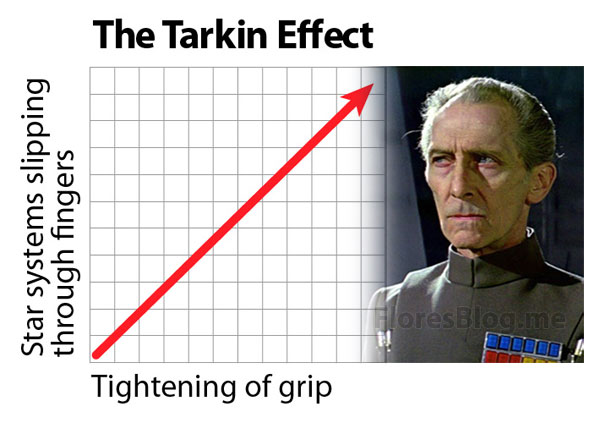
Groundlessness is a really interesting concept.  Although we know its truth, we ignore and resist it.  That is, we know from our own experience that everything changes, and that trying harder to seek solidity only causes more anxiety and stress.  The great philosopher Princess Leia once described it thus:
"The more you tighten your grip, Tarkin, the more star systems will slip through your fingers."
Princess Leia to Grand Moff Tarkin
We work very hard to try to get some ground underneath us and we fear uncertainty.  It's unclear to me why this is, however.  Almost everyone already has at least two clear insights.  First, we know that we become more anxious when we worry about things changing, and we produce more suffering when we try to hold on tighter.  Many people have seen this in romantic relationships - as one partner becomes clingier and tries to hold on tighter, it causes both people distress and ultimately damages the relationship.  Second, we know that we don't really know what will happen, and many times that's the most fun.  For example, I am planning a trip to France with my daughter - we have never been, and she is super excited because she doesn't know what it will be like.

We therefore know from our own experience that trying to hold onto certainty is distressing and that uncertainty can be pleasant.  So why do we fight it so much?

One reason is that this is, of course, an oversimplification.  Solidity can also be fun (at least for a while) and uncertainty can also be distressing.  Perhaps what we fear isn't really the uncertainty per se.  Perhaps what we really fear is the emotions we have to open ourselves to when we don't know what to expect.  This is why some people seem to be much more content to be unhappy all the time, holding on to a limited world view that everything sucks.  At least with this approach they can know what to expect and are rarely disappointed.  They have not yet become "disenchanted with suffering," and they work hard to make the ground of their lives as solid as possible.

The irony of this approach is that even the ground is not stable.  Even if you were to sit as still as possible on the cement, the earth is spinning at about 1,038 miles per hour, and the earth is moving around the sun at 67,108 mph, and our solar system is moving around the galaxy at about 514,000 mph, and the galaxy is moving around the local galactic cluster at about 89,000 mph, and the local cluster is moving around the local supercluster at about 1,342,000 mph.  That means that sitting completely still, you are still moving at about 2 million miles per hour.  Furthermore, the ground itself is groundless...it is constantly changing in shape and constitution based on changing temperatures, weather, use, friction, decay, etc.

What if we stepped into the stream of uncertainty without resistance?  Pema Chodron says, "Something about 'nothing solid' begins to equal freedom....This moving away from comfort and security, this stepping out into what is unknown, uncharted, and shaky -- that's called liberation" (Comfortable with Uncertainty, pp. 43-44).  Ralph Waldo Emerson put it this way:
"People wish to be settled.  Only as far as they are unsettled is there any hope for them."

Monday, January 21, 2013

Disturbing Meditation Biases

I had an interesting American Buddhist experience last night.  I am currently in Singapore, and went to a New Kadampa Tradition meditation center (or centre, in Singaporean spelling).  I had been there once for a day retreat, but this was just a normal evening meditation session, with two guided meditations and a talk on the purpose of meditation in-between.  Perhaps I was just jet-lagged, but I found the discussion to be quite disturbing.

The discussion focused on the five stages of meditation, which include preparatory practices, contemplation (or analytic meditation), single-pointed concentration meditation, dedication of merit, and subsequent practice.  I am not going to describe all of these steps (unless someone requests it), but these are traditional (at least within some Mahayana and Vajrayana traditions).  What I was disturbed by wasn't the meditation approach itself, but the cultural framework around it.

For example, here is some of the language used:

  • The preparatory practices "prepare us for successful meditation by purifying hindrances caused by our previous negative actions, by accumulating merit (or good fortune), and by enabling us to receive the blessings of enlightened beings."   
  • "Meditation is a mind that concentrates on a virtuous object, and that is the main cause of mental peace....When our mind is peaceful, we are free from worries and mental discomfort, and we experience true happiness."
  • "If we train our mind to become peaceful we will be happy all the time, even in the most adverse conditions....Then day and night, in life after life, we will experience only peace and happiness."  (All quotes from The New Meditation Handbook, by Geshe Kelsang Gyatso)
As an American Buddhist not specifically tied to any one tradition, I have a hard time with some of the assumptions underlying these statements.  

First, Buddha made it clear that we should examine each proposition carefully and test its utility for ourselves, partly because everyone's path is unique.  "As the wise test gold by burning, cutting and rubbing it (on a piece of touchstone), so are you to accept my words after examining them and not merely out of regard for me," says Buddha in Jnanasara-samuccaya [Bht 285]. Therefore, I have a hard time with concepts that were discussed such as multiple lives, good fortune, good luck, and blessings of holy beings. These feel too much like superstition to me. I am not interested in getting more money, luck, or angels. Whether there are holy beings capable of bestowing blessings on me seems like exactly the kind of question that Buddha refused to answer in the Kalama Sutra (aka the Cula-Malunkyovada Sutta, Majjhima Nikaya, Sutta 63).  Whether or not such things exist are "not connected to the goal" of liberation from suffering, and therefore are distractions.

Second, I am uncomfortable with claiming that the goal of meditation is to be "happy all the time." I also dislike when someone says can experience "true" happiness with one approach, as if all of the happiness you normally experience isn't real and that only they have the "truth."  These ways of describing the goal seem to reinforce dualistic thinking - that things are good or bad, right or wrong, happy or distressing.  I don't want to be happy all the time!  Clinging to that goal will only cause me to suffer more.  If we believe the goal is to find some state of "true" happiness and to maintain it, then we will be greatly disappointed.  If we believe that only one person/religion/political party has Truth, we will enhance our suffering.

Ultimately, this approach to considering the benefits of meditation feels very selfish to me.  We want more blessings, more merit, more fortune, more happiness, etc.  These are just more of the same selfish goals that keep us unhappy!

I was quite aware, however, as I was having these uncomfortable feelings with the way meditation was being taught that my reaction demonstrated my own biases and limitations.  Why was I being so judgmental?  What are my assumptions that were being pushed against?  If I accepted what was being said rather than fighting it, could it give me a new insight?

I don't pretend to have any answers here.  The Buddha himself gave his teachings in what seem to be contradictory ways, based largely on understanding who his audience was.  Maybe we need to lure people into a regular meditation practice with thoughts of being happy all the time, because that's what will motivate them.  Maybe this approach was skillfully designed, because telling them that happiness and sadness are the same thing isn't really motivating.

Let's return to the question about what is American Buddhism?  In this case, it seems that my viewpoint has real trouble with things I can't see or test for myself (such as receiving blessings from enlightened extra-terrestrials), and that I don't want to escape from my situation to be in a state of constant bliss (there are drugs for that).  I don't want to be saved and I don't want my life to be different from how it is. Instead, I just want to accept it, feel it, and enjoy it (including the bad parts).  Nonetheless, I recognize that my biases are my biases, and they do not in any way diminish the validity of someone else's approach.

Ultimately, my discomfort with the meditation approach made it much more valuable.  I'll be going back.

Sunday, January 13, 2013

Buddhists and anime and ninjas, oh my!

Americans come to Buddhist practices for many reasons.  Tonight I got to learn a new one.

My experience is that most people who were not born into Buddhist families either begin to come to meditation groups or enter a more committed phase of practice when they are confronted with the truth of their suffering in a way that makes it unable to ignore.  Others recognize that they live in a way that feels unsettled or stressful, and they hope that mindfulness will teach them to get through the day in a calmer way.  For others (and this was more my approach), it is a gradual unfolding as the dharma becomes revealed over time, perhaps with moments of epiphany.

Tonight I was leading our Mindfulness and Meditation group, and we had some newer people there, one of whom was Chloe, a girl of about 8 or 9 who had come with her mother.  While I was setting up, I asked Chloe if she would like some crayons or something to do during the meditation.  She said, "Oh no, I like meditation!" I asked her if she thought she'd be more comfortable on a chair or on a cushion, and she thought she'd be more comfortable on a cushion.  So I took her to choose a zafu that she would like, and she helped her mother get set up.  She also informed me that she meditates in a different way than others, with her hands palms together, and first two fingers of each hand straight, and second two intertwined.

We began with a 10-minute settling meditation, then some open discussion about the book we're reading (Zen Heart), and then a longer guided meditation based on one of the practices.  During our discussion, I asked Chloe why she liked meditating.  She said because she likes the Japanese anime-style show, Naruto, in which some of the characters meditate.  Oh, and also there's a ninja.

Chloe had a difficult time with the longer meditation, and expressed the frustration many meditators feel at the difficulty of staying on the cushion.  She ultimately needed to leave a bit early.

Apparently we need more ninjas.

Saturday, January 12, 2013

What is American Buddhism?

For many years I have avoided writing a blog.  My question has always been, "Why would anyone be interested in what I had for breakfast?"  Although editors sometimes had an answer (my favorite was simply, "You'd be surprised."), I didn't see any need to try to put either my personal or my professional opinions onto the Internet.

So what has changed?  I have been considering several questions about Buddhism, and writing them often helps me to structure them more thoughtfully.  A blog seems like an easy place to write and amend them over time.  Furthermore, it might get some responses that would be interesting and valuable, if anyone reads it and comments.

Although I have been a student of Buddhism (and Taoism) for almost 25 years, it is only fairly recently that I have been willing to call myself Buddhist.  For most of that time I generally refused to pidgeonhole myself, and if cornered, I would usually say that I was a devout agnostic.  It was only when I was travelling to work in another country and was required to fill in a form that included identifying a religion that I finally was forced to state publicly that I was Buddhist.  Although this ultimately has been helpful to me, as I embrace the dharma in a more personal way, it has also raised more questions.  People want to know what kind of Buddhist I am.  Am I Zen, Tibetan, Insight, Shambhala, etc?  I do not come from a single lineage, and my only response has been that I am an American Buddhist.  But what is an American Buddhist? 

Religions (like languages) are constantly transforming, especially as they come into contact with other cultures.  Buddhism has many traditions, largely centered around geography.  As Buddhism spread, it adapted to fit the existing cultures and continued to change as it flourished within those cultures.  For example, as it moved into China and came into contact with Taoist thought, it brought forth Chan Buddhism, which when it moved into Japan became Zen.  Buddhism moved into the English-speaking West over 100 years ago (for a fascinating semi-personal account, read Christian Humphreys' history of the Buddhist Society in London, in A Buddhist Students' Manual, 1956).  It moved into America in the 1950s, merging with the Beat culture of the times, then the hippy culture of the 60s, and is finally beginning to mature.  But what is it?
I don't have an answer, but I have several possible questions, based largely on my perception of American culture.
  • Perhaps it is a straight-talking, and no-nonsense type of Buddhism - A practical Buddhism.
  • Perhaps it is grounded in empiricism - a scientific style, stripped of mysticism.  Perhaps it is the opposite - highly magical and evangelical (or maybe it's one way for "red" states and the other for "blue" states).
  • Maybe it is becoming more fundamentalist and outspoken.
  • Maybe it is a melting pot of all of the various Buddhist traditions (e.g., Hinayana, Mahayana, Vajrayana), with less emphasis on transmission through a single lineage.
  • Perhaps it is seen as the next new trendy thing to wear, or is a method for being perceived as novel and/or shocking.
  • Maybe it rests on an assumption that ancient Eastern wisdom is somehow better or more relevant than modern wisdom traditions.
  • Perhaps it provides a more healthy way to proclaim rebellion than smoking Marlboros.
  • Maybe it is becoming more individualistic rather than communal.
  • Maybe it is more arrogant than other forms of Buddhism, thinking that it alone has Truth.
  • Maybe it is more aggressive or violent in its approach to solving problems.
  • Maybe it is forgiving (or supportive) of shorter and shorter attention spans.
  • Maybe it provides a sense of belonging - a type of ancestral home that most Americans lack because of our mixed race heritage and our general willingness to change where we live, our jobs, and our marriages.
  • Maybe it is seen as the antidote to an increasingly complex and fast-paced environment?

The question of what is American Buddhism is, of course, a modern koan.  There is no single answer.  The answer is dependently arising within each individual and across time. 

I can only hope to give a sense of what I mean for myself when I define myself as an American Buddhist, rather than defining myself within a specific tradition.  My approach to Buddhism (at this particular point in my history) is that it is multiply determined - I draw from all traditions, seeking to find what works for me, knowing that my path may be different from someone else's, although both may be equally "true."  It is a philosophical Buddhism, rather than being mystical.  My Buddhism is very empirical in nature.  I am, by training and vocation, a scientist.  I often find deep parallels between what we are learning about scientific psychology, physical science, and Buddhist philosophy.  I expect I will write about these aspects quite a bit in the future.  Ultimately, it is very practical type of Buddhism. I find that it works, and that deepens my interest in studying and following the Dharma.

This is, of necessity, an incomplete answer.  What is American Buddhism to you?  Does it even exist?