Sunday, September 11, 2016

The Three Truths

I was recently in Australia and heard an aboriginal D'harawal people's dreaming story that discussed what are known to them as the Three Truths.  Gawaian Bodkins-Andrews defined the Three Truths as:The Lyrebird, who sought the three truths
  • Midan Yewing:  What you see
  • Barkolo Yewing:  What others see
  • Duragai Yewing:  What is
I find this to be a profound teaching, quite in line with Buddhist teachings on emptiness (shunyata) and nirvana.  We are often captured by what we think we are seeing and then hold it to be the whole truth. We usually go further than this, though, and tell ourselves stories about what is and what has happened, and we make ourselves the hero (or heroic victim) of the story. Yet, what we see is only one part of what is constantly unfolding, and once we label it we take away its vibrancy and vitality. 
Most of us have had the good fortune to realize that what others see can often be very very different from what we saw. If we're lucky, we used those occasions to undermine the certainty of our own position. We probably remained somewhat skeptical that their position was more accurate, because we also have a sense that there is a greater view that could include both views (and other views of which we aren't yet aware). That is, we sense that "what is" must be bigger than our limited views.
What I find to be so profound is that this teaching calls all three of these viewpoints "truths."  What you see, even though it's deeply limited, is still your truth.  What others see is their truth. What is is still another truth.  This teaching does not say that only what is can be the Truth.  This is similar to how Buddhism considers both relative and absolute truths. Absolute truth isn't more "true" than relative truth, even when they may appear to conflict. One goal of training is to learn to hold more than one truth at a time, and to be skeptical of all of our interpretations of them. This is why some Buddhist practices focus on keeping "Don't Know" Mind. Can we remember in each moment that there are more truths than ours, and none of them is as all-encompassing as What Is?

Image source: https://upload.wikimedia.org/wikipedia/commons/0/04/Menura_superba_-_Thomas_Davies.jpg

Monday, July 11, 2016

Finding Balance in an Unstable World

Like many people, I have been wishing for more balance in my life recently.  The political and social worlds seem chaotic and heartbreaking.  I spend many days chasing after deadlines that I am not sure I care much about.  I would like to spend my time in other ways, ways that feel more refreshing and energizing rather than draining and worrisome.  For the first time I'm beginning to miss deadlines, which is a clear indication that I've taken on more projects than I can accomplish.  I need to learn to say "no" to some things, but that is not a skill I have ever had.  How can I put things back into balance?
There are several difficulties on the path to achieving balance, but I'd like to consider two.  We often don't know where to start and we also don't know how it should end, because our vision about what balance would look like is often incorrect.  Let's look at the second problem first - what does balance look like?
If you are able, I'd like you to stand on one foot for 10 seconds.  What you will notice is that balance is not achieved by a lack of movement.  It is not stable, but is dynamic.  You are constantly shifting, moving this way and that.  This is balance.  We often incorrectly believe that balance should be stable and unchanging, but in truth, that isn't balance, that's death.  You will only stop moving after death.  As long as you are alive, balance is only able to be achieved by swinging between different poles.  Your breath goes in and out, and is balanced.  Your emotions go up and down, and are balanced.  If your emotions are only down, for example, then this may be depression and is an indication of an imbalance of certain brain chemicals.
So we need to stop thinking of balance as stablity, as something achieveable in one moment - it is only observed across time.  For example, work-life balance is not something that will look the same every day.  Some days you will need to work more, and others you will skip work to do something important for your family.  This is balance.
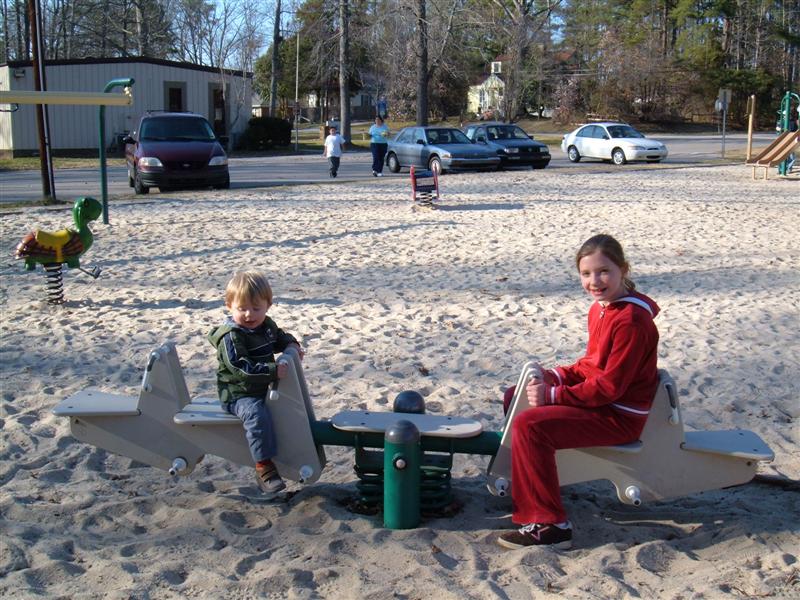
Recognizing the dynamic nature of balance can help to answer the first question - where should we start?  Many times we think we need to give something up or gain something special before we can balance our lives, but that thinking stems from the idea that balance is stability.  We are thinking about a physical balance, like a see-saw.  We need to move something off of our side to make it balance in the middle, or we need to get something on the other side.  Yet, even if we did give something up to make this side lighter, we would never achieve stability where the see-saw didn't move.  
To stay with the playground equipment as a metaphor, consider how you can make a swing go back and forth.  You first have to set an intention to shift your weight in one direction, and then the other.  Most of us don't actually even know what we're doing...an outside observer might just think we were sitting there not doing much, but setting the intention to move in one direction can help us to align multiple muscles and then we begin moving. 
This is one way to start.  What might help you to feel balanced?  Is it more exercise, more time for reading, eating better, etc?  Then set the intention to start moving in that direction.  Just going to the gym once won't make you feel balanced.  Even doing it daily for a month probably won't.  Because here's the secret - you're already in balance.  There is probably never going to be a day where you all of a sudden feel like everything is in perfect balance, and even if you do have a day like that, tomorrow will likely feel different because everything is in motion.  The balance point is you in the middle, and you're already there. You aren't out at the end of the see-saw - you're the point in the middle feeling the pulls this way and that.
We often believe that our ability to remain balanced is influenced by external situations.  In feudal Japan, a warlord and his army were attacking and conquering towns.  As they menaced a particular town, the townsfolk fled before the approaching army, with only the Zen master staying behind.  The warlord went to the temple to see what kind of man this master was.  The master was seated in the main temple.  When the warlord was not shown the fear and submissiveness which he was expected, he became angry and drew his sword, saying, "You fool!  Don't you realize that you are standing before a man who could run you through without blinking an eye?"  The master replied calmly, "Don't you realize that you are standing before a man who can be run through without blinking an eye?"
How did the master achieve such balance in the face of an external threat?  Here is where mindfulness practice is so useful, and this is a second place to start.  On the cushion we practice being less captured by our thoughts and feelings.  We are often pushed around by our feelings, believing that we must do something! in response to each of them.  Yet with practice, we begin to see that each feeling arises, abides, and passes gracefully.  We can sit with a sense of balance even when our emotions assail us.  With sufficient practice (such as the master had), we can learn to be balanced even when external events are turbulent and stressful.  From this place of balance, we will be much more able to respond in a skillful manner to all of the external situations (and also begin to realize that the "external" and "internal" situations are not separate).

Image sources:  AB, and C

Tuesday, June 14, 2016

The Strikingly Optimistic Agency of the Doctrine of Buddha Nature

A modern koan -- Question:  Do you have Buddha Nature?  Answer:  Well, duh.
The concept of "Buddha Nature" is often difficult to understand, but it is a radically optimistic doctrine.  It says that not only are we responsible for our lives, but that we already have everything we need to liberate ourselves from suffering.  If we compare it to many other religions, it is surprising how much agency this doctrine grants each of us individually. 
For example, consider the doctrine of original sin in Christianity – we somehow personally are separated from Grace because of something we didn’t do (eating the “apple” in the Garden of Eden).  Unfortunately we are also unable to heal this separation by ourselves.  We need an intermediary (Jesus) or two (and a priest) to bridge the gap for us.  That is, we had no agency over our own fall, nor do we have it over our salvation.  In contrast, Buddhism agrees that we fall from grace, but it’s because of something we did. In fact, we fall from grace regularly every time we do something harmful.  More importantly, however, we have the agency to fix the problems we create.  Indeed, we are really the only ones who can.
The great poet Ann Onymous once said, “A lot of growing up takes place between ‘it fell’ and ‘I broke it.’”  I personally believe that a mark of spiritual maturity is taking responsibility for one’s mind and actions.  The Buddhist project to me, therefore, is one of growing up – learning to see clearly the connected causes and conditions and to take responsibility for what we can when we can.  If “enlightenment” is some mystical state, then we are not granted agency over our own lives.  The Pali texts do not describe enlightenment as paranormal or external, but that enlightenment rises up in the individual, “as though he recognized it – had always known it” (Armstrong, 2001, p. 104).  That is, our own natures are sufficient, and we have full agency over our own salvation. 
Perhaps even more strikingly positive is the reason for the fall from grace/awakening/Nirvana/union with God.  In Christianity the reason is the inherent sinfulness of man (actually, since the Biblical texts were written by men, most of the blame is shifted to women).  In Buddhism, the reason for our bad behaviors is because of ignorance and confusion covering over our inherently good nature (Buddha Nature or Basic Goodness).  Thus we do not need an external agent or savior – we just need to see through the confusion and uncover our basic nature.  This is a powerfully optimistic doctrine.  We already have everything we need to awaken.  As noted by Thich Thien-An (p. 146), “Zen holds that reality is to be gotten hold of, not externally, but inwardly.  The truth is to be found in our own nature and nowhere else.  Every living being has within himself the Buddha nature, the principle of enlightenment.”
References:
                Armstrong, K. (2001).  Buddha. New York: Penguin Group.
           Thien-An, T. (1975). Zen philosophy, Zen practice. Berkeley, CA: Dharma Publishing.
Painting: Adam and Eve by Tintoretto; Originally published on the Interdependence Project blog

Monday, May 30, 2016

What is Mindfulness of Breath When You Can't Breathe?

Warning – I describe in some graphic detail the recuperation from a surgery.
Waking up after surgeryI wake up slowly in the recovery room, blood beginning to drain from my nose.  The next 36 hours will become an intriguing study of mindfulness, compassion, self-pity, and watching mind’s neurotic habits.  First thing I notice – I’m not blind.  They said there was 5% chance of blindness from this operation.  That did not seem like a small and comforting number to me.
It started about six months ago – I noticed that my lower left sinus cavity was beginning to feel blocked.  Three different courses of antibiotics over three months didn’t help.  The CAT scan showed that there was no space left in my left sinuses.  There were many nights where I became completely congested and couldn’t breathe, or could only with very strenuous pulling.  Doing mindfulness of breath meditation when one can’t breathe gives a new appreciation for it. 
I often liken mindfulness of breath meditation to working out with very heavy weights.  If you want to build muscle quickly, you do as many repetitions as you can with the heaviest weight you can.  Mindfulness of breath is like the heavy weight, precisely because it is boring as hell.  The breath is with us so constantly and effortlessly that it is very difficult to maintain attention on it.  This makes it easy to drop, and once dropped, easier to notice that we’ve lost focus.  This is why we don’t call watching television “meditating” – it takes no effort. 
When simple breathing takes effort, however, then meditating on it gets much easier.  It stops being boring when you feel like your lungs will never get the oxygen they need.  It stops being boring when you can’t sleep because you can’t breathe.
operating roomThe surgery was supposed to fix all this.  Unfortunately, by 5 hours after the operation the packing they had inserted into my sinuses has filled with blood completely closing off all air.  This makes swallowing impossible, as the suction needed to swallow creates tremendous pressure and pain in my sinus cavity.  I stop eating and drinking.  It hurts too much and I seem to be immune to the high-powered pain medicine they gave me.
I arrange the easy chair to try to sleep while allowing draining.  The problem is that although I can breathe a little from one nostril when awake, as soon as I fall asleep and relax the soft palate at the back of the throat, it closes down what little air passage I have and I wake up because I can’t breathe.  This means that I sleep in one-second intervals all night.  I do a lot of meditating on the breath, or lack thereof.
What is more annoying, however, is watching what my mind does.  Rather than simply note what is, it pays attention to every little change that seems worse and makes me worry.  Any time things ease up, it ignores that.  I have been told that I should take my narcotics before getting the packing removed the next day because the process is so painful.  Thinking of that keeps me awake.  I keep changing the blood-soaked bandages under my nose, not being particularly grateful that one side is clearly getting better.  By 4 am I am draining so little that I believe I can transfer from the chair to a bed.  I’ve never been able to sleep sitting up, so I am hopeful that I will finally get some of the sleep I desperately need.  Unfortunately, I still can’t breathe at all once I relax control over my throat.  I am not good at mouth breathing, and that seems especially unpleasant given that I had a tube stuck down my throat for the three-hour surgery.  So I continue to drift between daydreaming, resting, and focusing on every tiny change, generously remembering to wake myself up with regular thoughts of not only how much the packing hurts now, but how much it will hurt to remove.  Doing tonglen does little to settle me.  Feeling grateful that I am privileged to have medical care of this quality helps more.
By the afternoon of the next day, I am getting seriously dehydrated because I still can’t swallow.  The pain is reduced but I’m pretty shaky.  Having the packing removed hurts less than I expect.  Nonetheless, the nurse kindly wipes the tears off of my cheek with gauze.  After all the cleaning out is complete, I can feel so much air going through my sinuses that it almost hurts.  I haven’t breathed like this in months.
Unfortunately, within minutes (really, only minutes!) I am already ignoring the breath.  Once it has become easy again, it disappeared.  No more am I aware that I am breathing in long, or short, or laboriously.  Mind is a fickle a**hole.  It is already off wondering whether the lab tests will come back next week showing cancer.

Image sources: HERE and HERE - This was first posted on the Interdependence Project blog.

Thursday, June 18, 2015

Why every experience you have is 99% wrong

I sat outside on a lovely early summer morning. The sun played hide-and-seek with the clouds, who in turn were playing chase with the breezes. The garden had turned a rich green from the recent rains, and the strawberry flowers whispered of treats to come in a couple of weeks.  I set my meditation timer for 24 minutes, and set an intention to be aware of the arising and passing of sensations.

As the sun came out, I felt my skin warm.  As the breeze played tag, I felt my skin cool. Birds of many types sang from unseen places, although sometimes they passed before my eyes. A male and female cardinal eyed me suspiciously as they considered the bird feeder nearby. Their suspicion proved well-founded once they realized there was nothing in it.  The sound of cars arose and passed. I tasted my coffee, and savored the bitterness tempered by the teaspoon of sugar I had added. I noticed the heat of the coffee through the cup, and also saw the feeling of dislike arise as the heat felt like a threat.  I quickly put the cup down, but later picked it up again just trying to feel the arising of heat without judging it as aversive. I watched my thoughts sometimes follow my experiences, and sometimes lead them.

Perhaps this sounds like a "good" meditation session. What surprised me was the thing I called "my experience."  I was aware of each of these aspects of life's flow around and within me.  How disappointing.  I was aware of each of them.  One.  At.  A.  Time.

This thing we call our experience is only a tiny slice of what we are actually experiencing.  When noticing the breeze upon my skin, I wasn't also noticing the birds or the color of the grass.  In fact, I wasn't even noticing the breeze upon my skin - I only noticed it on certain parts of my skin where I focused my attention.  I was actually feeling it on my whole body, but only attended to how it cooled my legs or chest. Once it passed, I noticed the sound of some bird, but just that one - not all the other sounds, such as the wind in the trees, the myriad birds farther away, the sound of my heart beating, or the strawberries flowering. Tasting my coffee clouded all awareness of sights, sounds, feelings. Yet, all of these experiences were occurring at once.  Why do we believe experience is singular?

Attention is like a spotlight - it can focus on only one thing at a time. Worse still, it's a very narrow beam of light.  It can pick up only about 1% of what is happening at any given moment. To put it another way, that means that our understanding of what is occurring at any moment is 99% wrong! And still we persist in the belief that we are always right and know what's going on.

How would it be if we could truly experience the emptiness and multiplicity of experience, without the constant narrowing, labeling, and solidifying?

Monday, February 23, 2015

Singing the Song of Being

Beginning a mindfulness meditation practice is difficult.

You worry whether you’re doing it right.  You want to know what you’re getting into, but it’s hard to know what the benefits will be.  It is hard to know whether it’s worth the effort.  It often isn’t as relaxing as you imagined.  It’s hard to know how your path through the practice will be similar to anyone else’s.  It is perhaps because of these difficulties that many of the classical Buddhist teachings are in the form of similes, stories, and metaphors.  We can’t tell you exactly what will work for you or how to go about it, but we can hint at it.

One arm of the Eightfold Path that is particularly difficult to describe clearly is the one about Right Effort.  How much and what kind of effort is “right?” (I tend to prefer the terms “skillful” or “appropriate” rather than "right.")  The answer to this depends partly on your intended goal and the path you want to take to achieve it.  The classic story about skillful effort is from the Sona Sutta, about a monk named Sona who was trying too hard to achieve enlightenment.


According to the story, Sona had been practicing walking meditation so hard that his feet were bleeding and he became despondent and considered giving up his life as a monk.  To paraphrase, the Buddha knew that Sona had been a skilled vina player prior to being a monk (a vina or veena is an ancient Indian stringed instrument that is played by plucking it).  Buddha asked him, “when the strings of your vina were too taut, was your vina in tune and playable?" to which Sona answered “No.”  Buddha then asked him, “When the strings of your vina were too loose, was your vina in tune and playable?" to which Sona answered again “No.”  Buddha concluded by saying that in the same way, when we hold our minds too tightly we become restless, and when we hold them too loosely we become lazy.

Although this part of the story is fairly well-known, the sutra continues at some length.  Apparently this instruction was beneficial for Sona, because he figured out the right amount of effort and achieved enlightenment.  From this point on, however, the sutra gets weird (my opinion only).

Sona seeks out the Buddha apparently to show off how enlightened he is, and seems to brag about his achieving liberation and his dedication to only six things: “renunciation, seclusion, non-afflictiveness, the ending of craving, the ending of clinging/sustenance, and non-deludedness.” He continues by saying that having achieved this imperturbability, when his experience includes powerful forms, sounds, smells, tastes, feelings, and ideas, “his mind is neither overpowered nor even engaged” [emphasis added].

What strikes me as odd is that I doubt that these are the goals most modern American Buddhists have.  Some of them sound great – I’m all for ending ignorance/confusion, not being afflicted, and not being driven by cravings.  I even like the idea of being imperturbable when things get nutty.  Nonetheless, I don’t really want to be secluded from others or disengaged from my life and the powerful experiences that occur. I want to be deeply involved and moved by my experiences, without being controlled by them.

Perhaps this sutra is designed to be a model for those entering the priesthood and not for householders.  Perhaps it has lost (or gained) something in the translation.  Perhaps I am simply misunderstanding its deeper meaning, but maybe there’s another way to consider this story without it seeming so stark.
  
Instead of simply asking the question about what allows the string to be in tune and playable, what if we asked the question about how we can make music?  Even once the string is tuned properly there is no music.  If we simply hold the string we get no music.  If we space out and pay attention to something else we get no music.  It is only by a process of placing and releasing our fingers on the strings that they make a sound, and we must return constantly to the strings to play the next notes of the melody.  In a like manner, if we try to hold our minds or our breath too steadily, we are not allowing ourselves to breathe and feel naturally – to sing the song of our being.  If we space out and chase our thoughts, we similarly are not fully engaged in our lives.  It is only by constantly lightly touching our experience with awareness and returning it to mindfulness that we feel and sing the living song of our being.

Picture sources: Here and here.

Monday, November 3, 2014

Were you free to make a choice you didn't know you had? Where free will begins.

In a previous post, I asked you to consider the example of someone insulting or offending us, we get angry and immediately think of things we would like to say or do in response.  What would our motivation be for saying or doing any of them? Although you could spin it in several directions, such as to clarify the others’ mistake, to defend yourself, to get back at him/her, to put the other in his place, to just hit him, etc., they actually have one thing in common – they are motivated by the feeling that they will make you happier if you do it. 

Now here’s the funny thing – if you were to examine the motivation behind why the other person said or did whatever it was that he did, it’s exactly the same reason.  He thought it would make him happier.  In this respect, you two are always on the same wavelength. So one way to work with the negative feelings is to recognize that there is no fundamental difference between either of your perspectives. The problem is that our perspective usually does not include the other’s perspective. 

Humans suck at seeing another’s perspective.  There are many reasons for it, but a lot of it is just how the human brain works.  There is a cognitive bias that is so basic to all human thought that it is called the Fundamental Attribution Error.  When someone does something, especially something annoying, we tend to attribute the causes to something internal and/or essential about that person - he is just a jerk. In contrast, when we do something that could be annoying, however, we tend to attribute the causes to external situations.  We had no other choice, or we're in a hurry.

It's interesting to note that to ourselves, we always have a “good” reason for why we are doing whatever selfish thing it is we’re doing.

The corollary to the fundamental attribution error is what might be called the fundamental self error – that we relate everything to ourselves as if everything is a personal affront or benefit. The other part of a fundamental self error is that we believe there is a fundamental self – something unchanging at the core that things happen to. If we’re a stable permanent thing, then any changes that occur are from the outside happening TO us. We get to pretend constantly that we’re the victim, even of our own feelings. For example, how often have you said, “That thing you did MADE me mad,” or “I fell in love with you because you’re so sweet?" We interpret even our own feelings as something that happened to us because of external circumstances.

The irony is that we take no responsibility for our own actions and reactions, but we call this freedom.

Wouldn’t true freedom be the ability to not feel controlled by the situations and our emotional reactions? Wouldn’t true freedom be the ability to see all the perspectives?  If we believe that free will is the ability to make our own choices, when our perspective is so narrow that we can’t even understand the choices available to us, how can we have any free will? Were you free to make a choice that you didn’t even know you had?

Psychologist Roy Baumeister said, “Self-control counts as a kind of freedom because it begins with not acting on every impulse. The simple brain acts whenever something triggers a response: A hungry creature sees food and eats it. The most recently evolved parts of the human brain have an extensive mechanism for overriding those impulses, which enables us to reject food when we’re hungry, whether it’s because we’re dieting, vegetarian, keeping kosher, or mistrustful of the food.” 

So freedom begins when we STOP acting, or at least slow down the reacting. This is also the first step to being open to seeing other perspectives.  As long as we continue to act in our habitual ways, getting into the same arguments over and over again, continuing to believe that we're right, we will never be free.

This is where meditation can be such valuable training. One technique that can help us begin to slow the automatic processes of reacting down is called Urge Surfing, which can be read about here and there is a nice short guided example available here.


Image sources: Here and here.