Showing posts with label ignorance. Show all posts

Thursday, June 18, 2015

Why every experience you have is 99% wrong

I sat outside on a lovely early summer morning. The sun played hide-and-seek with the clouds, who in turn were playing chase with the breezes. The garden had turned a rich green from the recent rains, and the strawberry flowers whispered of treats to come in a couple of weeks.  I set my meditation timer for 24 minutes, and set an intention to be aware of the arising and passing of sensations.

As the sun came out, I felt my skin warm.  As the breeze played tag, I felt my skin cool. Birds of many types sang from unseen places, although sometimes they passed before my eyes. A male and female cardinal eyed me suspiciously as they considered the bird feeder nearby. Their suspicion proved well-founded once they realized there was nothing in it.  The sound of cars arose and passed. I tasted my coffee, and savored the bitterness tempered by the teaspoon of sugar I had added. I noticed the heat of the coffee through the cup, and also saw the feeling of dislike arise as the heat felt like a threat.  I quickly put the cup down, but later picked it up again just trying to feel the arising of heat without judging it as aversive. I watched my thoughts sometimes follow my experiences, and sometimes lead them.

Perhaps this sounds like a "good" meditation session. What surprised me was the thing I called "my experience."  I was aware of each of these aspects of life's flow around and within me.  How disappointing.  I was aware of each of them.  One.  At.  A.  Time.

This thing we call our experience is only a tiny slice of what we are actually experiencing.  When noticing the breeze upon my skin, I wasn't also noticing the birds or the color of the grass.  In fact, I wasn't even noticing the breeze upon my skin - I only noticed it on certain parts of my skin where I focused my attention.  I was actually feeling it on my whole body, but only attended to how it cooled my legs or chest. Once it passed, I noticed the sound of some bird, but just that one - not all the other sounds, such as the wind in the trees, the myriad birds farther away, the sound of my heart beating, or the strawberries flowering. Tasting my coffee clouded all awareness of sights, sounds, feelings. Yet, all of these experiences were occurring at once.  Why do we believe experience is singular?

Attention is like a spotlight - it can focus on only one thing at a time. Worse still, it's a very narrow beam of light.  It can pick up only about 1% of what is happening at any given moment. To put it another way, that means that our understanding of what is occurring at any moment is 99% wrong! And still we persist in the belief that we are always right and know what's going on.

How would it be if we could truly experience the emptiness and multiplicity of experience, without the constant narrowing, labeling, and solidifying?

Sunday, October 19, 2014

The Wisdom of Anger and the Illusion of Freedom

Anger is a funny emotion, because although it often causes us and those around us suffering, we deep down kind of like it.  We like the feeling of power it gives, the sense of righteousness that sometimes accompanies it, and the feeling of control we can get through it. So although we know we suffer because of it, we often don't really want to change our relationship with it.

Although we believe that our experience of reality is like a camera recording perfectly what it sees, our experience of reality is in fact an active creation of our minds.  If we can watch the cause and effect nature of our perceptions, thoughts, and feelings, we can become more accurate and more competent creators of our experiences.

Emotions affect thoughts, thoughts affect emotions, both affect behavior, and each thought or feeling helps to give rise to the next one.  Thoughts beget like thoughts, which is why positive or negative self-talk is important, and also part of why the meditative techniques can have powerful effects.

Let’s talk for a bit about the cycle of what normally happens with anger.  You may be going along, minding your own business doing your job, when your boss comes up and says something that really irks you.  This gets an immediate emotional reaction, which begins a cascade of thoughts, which often intensify the emotion, which continue the thoughts, etc.  As noted by neuroscientist Jill Bolte Taylor, any emotional reaction will run its full course physiologically in 90 seconds unless we continue to feed it.  Our attention gets focused, by which I really mean limited. We perseverate on the issue, and even when we try to stop thinking about it and to get some work done, we often find ourselves distracted by rehearsing some aspect of it again which just keeps the feeling going.  How many of you have had this experience?

The Tibetan word for this stuckness of our emotional reactions is shenpa.  It’s not the emotion itself, but the way that our experience of emotion narrows our vision, enhances the feeling of self and other, and captures our attention.  It is related to our past conditioning, in that we tend to have much the same reactions over and over, even to new insults.  

Recall the classic psychological study of conditioned emotions on Little Albert. Although he initially was not scared of small animals, by pairing the sight of a white rat with a loud sound, he learned to fear not only the rat, but other small animals like white and brown rabbits.  It is likely that for the rest of his life he would have had a habitual reaction to any new white rat or small animal.  He will think that his anxiety is "his."  He won’t remember why he has these feelings, just will accept them as if they are truth and that he's always felt this way.  We do this all the time – we have a reaction that is largely controlled by our past conditioning. The funny thing about it is that we believe it is freedom.

One way karma can be defined is it is an acquired loss of free will (thanks to Ethan Nichtern for this definition).  When we are stuck within the cascade of emotional and cognitive reactions, we are almost always thinking and feeling in ways that have we have practiced many times before.  This is why we have the same arguments over and over with our spouses, parents, children.  We are sick of the argument, and yet we don’t seem to ever find a way out.  If someone tells you that you need to stop reacting the same way, you feel outraged that they’re taking away your freedom.  But are you really free?  The only way to truly exercise freedom is to refrain from doing what you want to do long enough to be able to choose thoughtfully, not based on an emotional reaction or on habit energy.

I do not mean, however, to suggest that we shouldn’t be guided by emotions, nor do I mean to suggest that emotions are somehow bad or that we should learn to reduce or eliminate them. Instead, the Vajrayana view of emotions is particularly useful here - we need to see that emotions have co-emergent properties of wisdom and confusion.  These two properties co-emerge almost at once when you feel an emotion.  The trick is to learn to separate them and to act only from the wisdom side.

The wisdom of anger is seeing clearly that something is wrong.  There has been some injustice, or some goal has been frustrated.   Notice that this wisdom doesn’t necessarily say what one should do.  Finding the skillful action to take is entirely dependent on the exact situation at that moment, which is why our habitual reactions are almost never skillful. It may be that the skillful action to take is no action.

If we act on the wisdom component, it should usually help the situation.  If we act on the confusion component, it will often harm the situation or the other person.

How can we tell the difference?  First, we have to learn to refrain from following our usual patterns.  Until we do that, we cannot even begin to see how our actions contribute to the problems. People don’t like talking about refraining, because they incorrectly believe it is taking away their free will when in fact it is the first step on restoring it to them.

Second, we can begin to watch the course of cause and effect.  Why do we feel what we do?  What exactly do we feel? It’s not usually as simple as simple anger – there’s usually hurt, disappointment, a feeling of loss of control, old resentments, etc. that jostle with it.  We can try to trace where some of these feelings and thoughts come from. We can also watch what happens once we think something – how does it affect our feelings and future thoughts.  Finally, we can watch what happens once we do or say something – how does it change the situation for better or for worse?

Third, we need to begin to understand our motivations for taking action.  Unfortunately, most of our motivations are actually hidden to conscious thought.

For example, Wayne Warburton and his colleagues have done a series of interesting studies about why people behave aggressively when made upset. Here's the general (over-simplified) setup:  First I insult you in some way, so that you are angered.  Then you are put in a room alone and told that you will have to endure a really loud and unpleasant noise for about 30 seconds.  Participants are randomized into a no-control or a having-control condition. In the no-control condition, the noise just comes on at some point. In the having-control condition, you have a button you can press to start the noise when you are ready for it.  In both cases everyone hears the same unpleasant noise.  After hearing it, people are given an opportunity to be mean to someone else (such as the person who insulted them). If they were in the no-control condition, they are much more aggressive than if they had been given a small sense of control from getting to push the button to start the noise.  This (among other experiments they conducted) shows that we will behave aggressively partly to regain a sense of control.  

Given that these motivations to restore a sense of control are unconscious, it takes a lot of work and time to begin to notice what is truly motivating our actions. The story we tell about why we do something is almost never accurate, because it’s designed to show you off in the most positive light possible (both to others and to self).

So if this the steps above will take a lot of training, what can we do right away? We can try to notice the feeling tone that goes with our action, because that’s a little more observable to conscious awareness.   If we are acting with an angry feeling, then whatever action we have chosen is almost certainly coming from the confusion side.  Buddha said that hatred is never solved by hatred.  If instead we act out of a feeling of compassion, then the action has much higher likelihood to work from the wisdom side.

Within the Buddhist framework, we build our karma primarily from intentions. So the same action could build positive outcomes and habits or negative outcomes and habits, depending on the intention behind it.

Going back to the example of someone insulting or offending us, we get angry and immediately think of things we would like to say or do in response.  What is our motivation for saying or doing any of them? Although you could spin it in several directions, such as to clarify the others’ mistake, to defend yourself, to get back at him/her, to put the other in his place, to just hit him, etc., they actually have one thing in common – they are motivated by the feeling that they will make you happier if you do it.  So your motivation is driven by a self motivation. This will almost ensure continued or enhanced division.  This is the confusion aspect of the emotion.

What if, instead, we acted from a motivation of compassion?  This is the wisdom aspect of anger – something is wrong, and we have an opportunity to try to help the situation. So consider the anger that might be built up if one lived with an alcoholic. Tara Brach (Radical Acceptance, 2003, pp. 296-297) relates the story of a family setting up an intervention to send a loved one to a treatment program.  
"I worried about how the participants - his wife, two sons and elderly father - were going to manage being 'loving and nonjudgmental' when each one was so furious with him. They were filled with grievances: the sons who couldn't bring friends home from school because their father was such a loose cannon; the wife who had lost a partner she could count on and who treated her with care; the father who never saw his only son. I feared they'd just curse him out, rather than communicate their caring. 
"I was wrong. Harry came into that room and, he later told me, looked around at the faces of those he loved best in the whole world. They were all looking at him, all there for him. Something happened to the air in the room, he said, it seemed to beat like a pulse. After he sank down in a chair, I suggested that Marge, his wife, begin the confrontation. But, instead of reciting his absences, his missed commitments, she just got up and kissed him. 'Thank you for coming, Harry,' she said. Then, to my surprise, each of the others, even the boys, got up and hugged him....When his family did go on to say what needed saying, Harry was listening. Afterward, he took the [space in the treatment facility] that had been saved for him."
Notice that this approach does not try to eradicate anger, but is about learning to use its wisdom and energy in a way that benefits others rather than satisfies the self.

Above I noted that Buddha said that anger and hatred are never solved by hatred. That is only the first part of what he said – he also said what can solve it:
Animosity does not eradicate animosity. Only by loving kindness is animosity dissolved. This law is ancient and eternal.
- The Dhammapada (translation by Ananda Maitreya, 1995, Parallax Press)

So loving kindness is the direct antidote to anger, and it can help to solve the problems that are fostered and nourished by anger. This approach, however, doesn't come naturally to everyone, but it IS something that can be trained in anyone (although it again takes time).  The technique is called metta or loving-kindness meditation (for more details, see HERE or HERE). Practicing this can begin to train us to be guided by and act from the wisdom side of anger, rather than the confusion side. Gaining relief from our habitual feelings and response patterns truly gives us freedom, rather than the illusion of freedom that we usually have.


Image sources: Herehereand here. This was first published at www.theidproject.org

Sunday, September 28, 2014

The Two Arrows

I've been thinking about how relationships, mindfulness, and meditation work.  All of them seem to share a striking characteristic.  When everyone is happy, they all seem to flow easily.  But when someone is feeling a strong emotion (e.g., anger, fear, jealousy, sadness), they all seem to get harder. This is perhaps one of the real benefits of working on mindfulness in a supportive group - it's not like we're leaving the world behind.  We bring it with us all the time.  Meditation offers us an opportunity to practice the hard things in a little simpler and safer way, so that then we can practice them in the "real" world more easily later.

So, this is one of the goals of mindfulness: to allow us to go through the ups and downs of daily life with a sense of ease, to gain clarity into what is actually happening so that we can act skillfully and thereby make problems better rather than adding fuel to the fire.  In this spirit, the next several posts will examine aspects of dealing with relationships skillfully, even when we're in the middle of a difficult emotion.


To start, consider this question: How often do we say “You did this to me!” when what we really mean is “I didn’t get what I wanted?"

There is a classic Buddhist parable of the two arrows. In brief, the idea is that most people, when hurt, add to the hurt. If shot with an arrow, we spend a lot of effort focused on wondering why we got shot, how we didn't deserve that, how the person who shot the arrow is a  jerk, what we are going to say when we get in front of him/her, etc.  It's like being struck by a second arrow - the first one is physical and the second is mental.  In contrast, if we are able to maintain our mindfulness and not spin off into a story about our pain, we only get struck by one arrow. (For the geeks, here is the original Sallatha Sutra).

I might even go further than this - once we start down the story road, we not only make ourselves feel worse (the second arrow), but then we are more likely to do something that makes the situation worse.  This is a third arrow!

We need to take responsibility for our emotions. We need to stop thinking that something outside us will make everything better. All you can work with is yourself, and this is true even for recurring situations. If you have a difficult boss who makes your life difficult, it is unlikely that you can change your boss. You can, however, change your reactions, your work habits, or even your job.

If we look a little deeper into any interaction, we will notice that whenever someone does something to you, you are at the same time perceiving it.  To quote Ethan Nichtern's riff on the classic Zen koan, "If a person is an ass and there's no one around to see it, is he still an ass?"

We expect that our perception and our point of view is accurate and that any other observer would agree with our perception. This is called the False Consensus Bias, where we assume that whatever we think/feel, most people would agree with.  The classic study (Ross, Greene, & House, 1977) had people read stories that included a conflict and asked them which solution most people would pick, which one they themselves would pick, and what people who pick each of the two sides would be like.  In general, people estimate that most people would pick the same choice they themselves would, and rated them more positively than people who would pick the other choice.


Attention is a narrow spotlight - look at something in your room right now.  As you focus on that 5% of the room, you can't pay attention to the other 95% of what is actually happening now. Your perception is therefore always 95% wrong, and your memory is even worse (especially once you start telling yourself a story about what just happened). So although we can’t overcome the false consensus bias, we can start to recognize that we never have all the information, and that from the other person’s point of view, maybe you’re the ass. 

In truth, usually no one is the ass. We actually just have different perspectives, attention to different aspects, different goals, different motivations, and different approaches.  But because we assume that everyone else must have the same perspective, goals and approaches, we then decide that anyone not following our script must be being difficult.

If we can begin to see that we are very changeable based on what we pay attention to, it may give us the space to pause before we shoot ourselves with the second arrow.

Saturday, April 27, 2013

Getting What You Want Isn't What You Want - The First Noble Truth


Gautama Buddha, the historical Buddha, lived between about 563 and 483 BC in India on the border of present-day Nepal. He was a son of the King Sudhodana, ruler of  the tribe called the Sakyas (from where Buddha derived the title Sakyamuni, meaning "Sage of the Sakyas"). The young prince also received the name of Siddhartha. He maintained a privileged life behind the palace walls until one day he decided to visit the nearby town. The king called for everything to be swept and decorated, and any disturbing, unpleasant, or sad sight to be removed. But while Gautama was travelling through the streets, an old wrinkled man appeared before him. In astonishment the young prince learned that decrepitude is the fate of those who live long enough. Later he saw someone seriously ill, and then a funeral procession with a corpse, both of which opened his eyes to suffering and death. Finally he met an ascetic, a beggar, who told Gautama that he had left the world to pass beyond suffering and joy, to attain peace at heart.

Gautama left his palace, wife, and child, and became an ascetic for about 6 years, desiring to understand and eliminate suffering.  Although he achieved deep meditation states, his body suffered and he did not achieve peace.  Finally, he achieved the realization that there is a middle way between selfish indulgence and asceticism.  He became aware of what are now known as the Four Noble Truths – that suffering (dukkha) is universal, the cause of suffering, that suffering can be overcome, and the path by which it can be overcome.  With this insight, he became the Buddha, which simply means one who is awake.

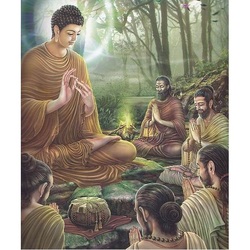
About seven weeks after the Buddha’s awakening, he met five former ascetic companions, and the Four Noble Truths are seen as the first teaching he gave.  The four truths are not as such things to “believe,” but to open to, contemplate, see for yourself, and respond to.  In this post, we focus on the first of the Noble Truths - that dukkha exists. (If you want to read some of the details, see HERE)


Dukkha: Although this is usually translated into English as suffering, dis-ease, unsatisfactoriness, discomfort, anxiety, and stress may be somewhat better. There are several types of dukkha.  Gompopa (in the “Jewel Ornament of Liberation”) organizes them into these three types:

1. Dukkha - Dukkha (Suffering of suffering):  Ordinary suffering or pain, which can be physical, emotional, or mental

2. Viparinama Dukkha (Suffering of Change):  Suffering brought on by the truth of impermanence, and our desire to keep things from changing. 

3. Samkhara Dukkha (Suffering of Conditioned States; All-Pervasive suffering):  This is the trickiest to define.  It's basically suffering brought on by our neurotic habits, by being a self with the Five Skandhas (the five aggregates that we mistake for “self”), which are constantly changing.  In brief, we have bodies and things have forms, we have sensations and feelings, we have perceptions and cognitions, we have thoughts, opinions, prejudices, and attitudes, and we have consciousness.  One way of thinking about it is that these five Skandhas maintain a reference to "self," which causes us to separate the world into self and other, which can cause suffering.

As you might have noticed from this list, suffering is much more complicated than it at first appears.  In fact, the Buddha defined eight types: 
"Now this, monks, is the Noble Truth of dukkha: Birth is dukkha, aging is dukkha, death is dukkha; sorrow, lamentation, pain, grief, & despair are dukkha; association with the unbeloved is dukkha; separation from the loved is dukkha; not getting what is wanted is dukkha. In brief, the five clinging-aggregates are dukkha."  SN 56.11 

I tend to think that  there is a ninth type of suffering - getting what we want.


Think about it.  As soon as you get that thing you really desired, you start worrying about it.  You get the fancy car and then begin stressing about it getting door dings, or breaking down, or stolen.   Getting what you want begets dukkha when it gets boring (aging), when it breaks (death), when we worry about it getting stolen or harmed (distress), or after we've lost it (separation from the loved).

Basically, there is a dependent co-arising of both happiness and stress when we get what we want.  

One place one can often see this clearly is in our romantic relationships.  The very thing that attracts you so much to a person is usually the exact thing that is particularly annoying later on.  For example, you are attracted to someone because of how flirty he is?  He won't stop being flirty after he's with you, and then you might not like it as much.  You are attracted to how free-spirited she is?  It will be annoying when she doesn't fit neatly into the little box you would like to keep her in once you're together (c.f., the home for manic pixie dream girls video).  You are attracted to how smart someone is, and what a great probing intellect he/she has?  You might not like it later when he/she turns that probing critical mind on you!

The point is that we continually believe that getting what we want will make us happy, but that's clearly not true.  Most of the time, getting what we think we want just maintains our suffering.

The good news is that the next three Noble Truths help us to understand why we suffer and how to stop.


Sunday, February 17, 2013

Ernest Hemmingway and Emptiness (Shunyata)

In 1933, Ernest Hemmingway wrote a three-page short story, titled A Clean, Well-Lighted Place.  It's a masterpiece of writing technique, and valuable for study simply for that.  But for such a short piece, it is a profound description of the human condition as it relates to the Buddhist concept of Śūnyatā, which is often translated as emptiness or nothingness.

Westerners often become acquainted with this when hearing how Buddhists talk about non-self or egolessness.  This is a difficult concept, and it usually gets misinterpreted in one of at least two ways.  It can sound like Buddhists think you don't actually exist, or that Buddhism is nihilistic and that there is no meaning to anything.  This is incorrect.  Buddhism does not deny that you or anything else exists, but instead that everything exists dependently on everything else and is constantly changing - so there isn't a solid "thing" that is you.  You are different in each new situation and with each passing moment.  Furthermore, this understanding makes it clear that everything is actually much more meaningful than we usually realize.  If we are interconnected with everything else, then our actions matter for more than just ourselves.

Nonetheless, it is definitely disconcerting when you stare this truth in the face.  Realizing that everything you think you are is not accurate, that there is nothing solid and unchanging, and that there is nothing about you that is really "you" can be terrifying.  What happens when you come face to face with this nothingness?  Hemmingway describes three paths.  I recommend reading the story right now by clicking here.

There are three characters, the old man customer, the young waiter, and the old waiter.  Each has a different approach to dealing with the inherent emptiness of existence.

The Old Man

"Last week he tried to commit suicide," one waiter said.
"Why?"
"He was in despair."
"What about?"
"Nothing."
Facing the inherent instability of existence, what Pema Chodron often calls "groundlessness," the "fundamental ambiguity," or sometimes the "fundamental anxiety of being human," is scary.  I had a student who could easily be reduced to a terrified puddle of nonfunctionality any time she considered the fragility of her existence.  Indeed, there are whole branches of psychology (e.g., Terror Management Theory) devoted to describing this fear and our reaction to it.   The old man typifies one reaction - he despairs.
"He's drunk now," he said.
"He's drunk every night."
The old man tries to numb himself to the nothingness, and when even that doesn't work, he leaps into it trying to annihilate himself.

The Young Waiter

"I wish he would go home.  I never get to bed before three o'clock. What kind of hour is that to go to bed?"
"He stays up because he likes it."
"He's lonely.  I'm not lonely.  I have a wife waiting in bed for me."
The young waiter exemplifies another typical response - he works harder to hold onto his selfish point of view.  He clings to the perception that his way of seeing things is right and others are the selfish ones.

"I wouldn't want to be that old. An old man is a nasty thing."
"Not always.  This old man is clean.  He drinks without spilling.  Even now, drunk.  Look at him."
"I don't want to look at him.  I wish he would go home.  He has no regard for those who must work."
He refuses to look at truth.  Although the young waiter will get old like the customer, he wants instead only to rush off, distracting himself constantly and believing that his point of view is solid.  When confronted with the difficulties of life, compassion, and uncertainty, he rejects them and cloaks himself in confidence.
"No," the waiter who was in a hurry said, rising from pulling down the metal shutters. "I have confidence. I am all confidence."
The young waiter is a personification of Avidyā, or ignorance. Traditionally, this is one of the "three poisons," and is taken to mean a fundamental misunderstanding of the self as separate and solid. This is the not-knowing aspect of ignorance. The young waiter also demonstrates another aspect, however - the ignoring aspect of ignorance. He clings to his perceptions and actively ignores seeing anything else.

The Old Waiter

"I am of those who like to stay late at the café," the older waiter said. "With all those who do not want to go to bed. With all those who need a light for the night."
"I want to go home and into bed."
"We are of two different kinds," the older waiter said. He was now dressed to go home. "it is not only a question of youth and confidence although those things are very beautiful. Each night I am reluctant to close up because there may be some one who needs the café."
The old waiter demonstrates a more mature and wise approach. He does not deny the fear that comes with the fundamental groundlessness of existence - indeed, he feels it deeply.
What did he fear? It was not a fear or dread. It was a nothing that he knew too well. It was all a nothing and a man was a nothing too. It was only that and light was all it needed and a certain cleanness and order. Some lived in it and never felt it but he knew it was all nada y pues nada y nada y pues nada. Our nada who art in nada, nada be thy name...
This is perhaps a type of right view - seeing things as they are. There is nothing to hold on to, and there is nothing outside ourselves that can fix that. Nonetheless, shining a light on it helps - in contrast to ignoring it or masking it with external stimulation and diversion ("Certainly you do not want music.") You want to stand before it with dignity, and when you do you see that it is not as scary as it first seems. In fact, it has a type of orderliness to it that can be reassuring. Some of the fear comes from the words we use - we focus on words like emptiness, nothingness, and groundlessness. Instead, we could just as easily say "freedom." Because we are not solid, we have much more freedom to act, react, and feel than we usually believe.
He disliked bars and bodegas. A clean, well-lighted café was a very different thing. Now, without thinking further, he would go home to his room. He would lie in the bed and finally, with daylight, he would go to sleep. After all, he said to himself, it's probably only insomnia. Many must have it.
The old waiter still feels the anxiety. He cannot sleep in the dark. But he also recognizes that he is not alone - many must have this fear. For me, here is the heart of this parable. The old waiter not only can accept his own anxiety, but he has compassion for all others and the ways in which they deal with it, and he is willing to stay open later at night in case there is one whom he can help. This is the bodhisattva ideal - that as we achieve enlightenment, we remain open to help others who can benefit from it.