Showing posts with label perception. Show all posts

Sunday, October 19, 2014

The Wisdom of Anger and the Illusion of Freedom

Anger is a funny emotion, because although it often causes us and those around us suffering, we deep down kind of like it.  We like the feeling of power it gives, the sense of righteousness that sometimes accompanies it, and the feeling of control we can get through it. So although we know we suffer because of it, we often don't really want to change our relationship with it.

Although we believe that our experience of reality is like a camera recording perfectly what it sees, our experience of reality is in fact an active creation of our minds.  If we can watch the cause and effect nature of our perceptions, thoughts, and feelings, we can become more accurate and more competent creators of our experiences.

Emotions affect thoughts, thoughts affect emotions, both affect behavior, and each thought or feeling helps to give rise to the next one.  Thoughts beget like thoughts, which is why positive or negative self-talk is important, and also part of why the meditative techniques can have powerful effects.

Let’s talk for a bit about the cycle of what normally happens with anger.  You may be going along, minding your own business doing your job, when your boss comes up and says something that really irks you.  This gets an immediate emotional reaction, which begins a cascade of thoughts, which often intensify the emotion, which continue the thoughts, etc.  As noted by neuroscientist Jill Bolte Taylor, any emotional reaction will run its full course physiologically in 90 seconds unless we continue to feed it.  Our attention gets focused, by which I really mean limited. We perseverate on the issue, and even when we try to stop thinking about it and to get some work done, we often find ourselves distracted by rehearsing some aspect of it again which just keeps the feeling going.  How many of you have had this experience?

The Tibetan word for this stuckness of our emotional reactions is shenpa.  It’s not the emotion itself, but the way that our experience of emotion narrows our vision, enhances the feeling of self and other, and captures our attention.  It is related to our past conditioning, in that we tend to have much the same reactions over and over, even to new insults.  

Recall the classic psychological study of conditioned emotions on Little Albert. Although he initially was not scared of small animals, by pairing the sight of a white rat with a loud sound, he learned to fear not only the rat, but other small animals like white and brown rabbits.  It is likely that for the rest of his life he would have had a habitual reaction to any new white rat or small animal.  He will think that his anxiety is "his."  He won’t remember why he has these feelings, just will accept them as if they are truth and that he's always felt this way.  We do this all the time – we have a reaction that is largely controlled by our past conditioning. The funny thing about it is that we believe it is freedom.

One way karma can be defined is it is an acquired loss of free will (thanks to Ethan Nichtern for this definition).  When we are stuck within the cascade of emotional and cognitive reactions, we are almost always thinking and feeling in ways that have we have practiced many times before.  This is why we have the same arguments over and over with our spouses, parents, children.  We are sick of the argument, and yet we don’t seem to ever find a way out.  If someone tells you that you need to stop reacting the same way, you feel outraged that they’re taking away your freedom.  But are you really free?  The only way to truly exercise freedom is to refrain from doing what you want to do long enough to be able to choose thoughtfully, not based on an emotional reaction or on habit energy.

I do not mean, however, to suggest that we shouldn’t be guided by emotions, nor do I mean to suggest that emotions are somehow bad or that we should learn to reduce or eliminate them. Instead, the Vajrayana view of emotions is particularly useful here - we need to see that emotions have co-emergent properties of wisdom and confusion.  These two properties co-emerge almost at once when you feel an emotion.  The trick is to learn to separate them and to act only from the wisdom side.

The wisdom of anger is seeing clearly that something is wrong.  There has been some injustice, or some goal has been frustrated.   Notice that this wisdom doesn’t necessarily say what one should do.  Finding the skillful action to take is entirely dependent on the exact situation at that moment, which is why our habitual reactions are almost never skillful. It may be that the skillful action to take is no action.

If we act on the wisdom component, it should usually help the situation.  If we act on the confusion component, it will often harm the situation or the other person.

How can we tell the difference?  First, we have to learn to refrain from following our usual patterns.  Until we do that, we cannot even begin to see how our actions contribute to the problems. People don’t like talking about refraining, because they incorrectly believe it is taking away their free will when in fact it is the first step on restoring it to them.

Second, we can begin to watch the course of cause and effect.  Why do we feel what we do?  What exactly do we feel? It’s not usually as simple as simple anger – there’s usually hurt, disappointment, a feeling of loss of control, old resentments, etc. that jostle with it.  We can try to trace where some of these feelings and thoughts come from. We can also watch what happens once we think something – how does it affect our feelings and future thoughts.  Finally, we can watch what happens once we do or say something – how does it change the situation for better or for worse?

Third, we need to begin to understand our motivations for taking action.  Unfortunately, most of our motivations are actually hidden to conscious thought.

For example, Wayne Warburton and his colleagues have done a series of interesting studies about why people behave aggressively when made upset. Here's the general (over-simplified) setup:  First I insult you in some way, so that you are angered.  Then you are put in a room alone and told that you will have to endure a really loud and unpleasant noise for about 30 seconds.  Participants are randomized into a no-control or a having-control condition. In the no-control condition, the noise just comes on at some point. In the having-control condition, you have a button you can press to start the noise when you are ready for it.  In both cases everyone hears the same unpleasant noise.  After hearing it, people are given an opportunity to be mean to someone else (such as the person who insulted them). If they were in the no-control condition, they are much more aggressive than if they had been given a small sense of control from getting to push the button to start the noise.  This (among other experiments they conducted) shows that we will behave aggressively partly to regain a sense of control.  

Given that these motivations to restore a sense of control are unconscious, it takes a lot of work and time to begin to notice what is truly motivating our actions. The story we tell about why we do something is almost never accurate, because it’s designed to show you off in the most positive light possible (both to others and to self).

So if this the steps above will take a lot of training, what can we do right away? We can try to notice the feeling tone that goes with our action, because that’s a little more observable to conscious awareness.   If we are acting with an angry feeling, then whatever action we have chosen is almost certainly coming from the confusion side.  Buddha said that hatred is never solved by hatred.  If instead we act out of a feeling of compassion, then the action has much higher likelihood to work from the wisdom side.

Within the Buddhist framework, we build our karma primarily from intentions. So the same action could build positive outcomes and habits or negative outcomes and habits, depending on the intention behind it.

Going back to the example of someone insulting or offending us, we get angry and immediately think of things we would like to say or do in response.  What is our motivation for saying or doing any of them? Although you could spin it in several directions, such as to clarify the others’ mistake, to defend yourself, to get back at him/her, to put the other in his place, to just hit him, etc., they actually have one thing in common – they are motivated by the feeling that they will make you happier if you do it.  So your motivation is driven by a self motivation. This will almost ensure continued or enhanced division.  This is the confusion aspect of the emotion.

What if, instead, we acted from a motivation of compassion?  This is the wisdom aspect of anger – something is wrong, and we have an opportunity to try to help the situation. So consider the anger that might be built up if one lived with an alcoholic. Tara Brach (Radical Acceptance, 2003, pp. 296-297) relates the story of a family setting up an intervention to send a loved one to a treatment program.  
"I worried about how the participants - his wife, two sons and elderly father - were going to manage being 'loving and nonjudgmental' when each one was so furious with him. They were filled with grievances: the sons who couldn't bring friends home from school because their father was such a loose cannon; the wife who had lost a partner she could count on and who treated her with care; the father who never saw his only son. I feared they'd just curse him out, rather than communicate their caring. 
"I was wrong. Harry came into that room and, he later told me, looked around at the faces of those he loved best in the whole world. They were all looking at him, all there for him. Something happened to the air in the room, he said, it seemed to beat like a pulse. After he sank down in a chair, I suggested that Marge, his wife, begin the confrontation. But, instead of reciting his absences, his missed commitments, she just got up and kissed him. 'Thank you for coming, Harry,' she said. Then, to my surprise, each of the others, even the boys, got up and hugged him....When his family did go on to say what needed saying, Harry was listening. Afterward, he took the [space in the treatment facility] that had been saved for him."
Notice that this approach does not try to eradicate anger, but is about learning to use its wisdom and energy in a way that benefits others rather than satisfies the self.

Above I noted that Buddha said that anger and hatred are never solved by hatred. That is only the first part of what he said – he also said what can solve it:
Animosity does not eradicate animosity. Only by loving kindness is animosity dissolved. This law is ancient and eternal.
- The Dhammapada (translation by Ananda Maitreya, 1995, Parallax Press)

So loving kindness is the direct antidote to anger, and it can help to solve the problems that are fostered and nourished by anger. This approach, however, doesn't come naturally to everyone, but it IS something that can be trained in anyone (although it again takes time).  The technique is called metta or loving-kindness meditation (for more details, see HERE or HERE). Practicing this can begin to train us to be guided by and act from the wisdom side of anger, rather than the confusion side. Gaining relief from our habitual feelings and response patterns truly gives us freedom, rather than the illusion of freedom that we usually have.


Image sources: Herehereand here. This was first published at www.theidproject.org

Sunday, September 28, 2014

The Two Arrows

I've been thinking about how relationships, mindfulness, and meditation work.  All of them seem to share a striking characteristic.  When everyone is happy, they all seem to flow easily.  But when someone is feeling a strong emotion (e.g., anger, fear, jealousy, sadness), they all seem to get harder. This is perhaps one of the real benefits of working on mindfulness in a supportive group - it's not like we're leaving the world behind.  We bring it with us all the time.  Meditation offers us an opportunity to practice the hard things in a little simpler and safer way, so that then we can practice them in the "real" world more easily later.

So, this is one of the goals of mindfulness: to allow us to go through the ups and downs of daily life with a sense of ease, to gain clarity into what is actually happening so that we can act skillfully and thereby make problems better rather than adding fuel to the fire.  In this spirit, the next several posts will examine aspects of dealing with relationships skillfully, even when we're in the middle of a difficult emotion.


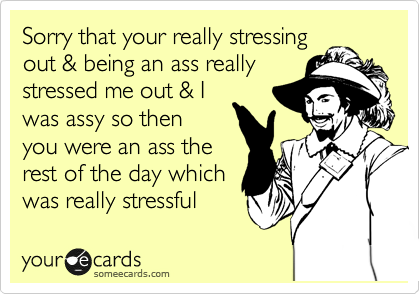
To start, consider this question: How often do we say “You did this to me!” when what we really mean is “I didn’t get what I wanted?"

There is a classic Buddhist parable of the two arrows. In brief, the idea is that most people, when hurt, add to the hurt. If shot with an arrow, we spend a lot of effort focused on wondering why we got shot, how we didn't deserve that, how the person who shot the arrow is a  jerk, what we are going to say when we get in front of him/her, etc.  It's like being struck by a second arrow - the first one is physical and the second is mental.  In contrast, if we are able to maintain our mindfulness and not spin off into a story about our pain, we only get struck by one arrow. (For the geeks, here is the original Sallatha Sutra).

I might even go further than this - once we start down the story road, we not only make ourselves feel worse (the second arrow), but then we are more likely to do something that makes the situation worse.  This is a third arrow!

We need to take responsibility for our emotions. We need to stop thinking that something outside us will make everything better. All you can work with is yourself, and this is true even for recurring situations. If you have a difficult boss who makes your life difficult, it is unlikely that you can change your boss. You can, however, change your reactions, your work habits, or even your job.

If we look a little deeper into any interaction, we will notice that whenever someone does something to you, you are at the same time perceiving it.  To quote Ethan Nichtern's riff on the classic Zen koan, "If a person is an ass and there's no one around to see it, is he still an ass?"

We expect that our perception and our point of view is accurate and that any other observer would agree with our perception. This is called the False Consensus Bias, where we assume that whatever we think/feel, most people would agree with.  The classic study (Ross, Greene, & House, 1977) had people read stories that included a conflict and asked them which solution most people would pick, which one they themselves would pick, and what people who pick each of the two sides would be like.  In general, people estimate that most people would pick the same choice they themselves would, and rated them more positively than people who would pick the other choice.


Attention is a narrow spotlight - look at something in your room right now.  As you focus on that 5% of the room, you can't pay attention to the other 95% of what is actually happening now. Your perception is therefore always 95% wrong, and your memory is even worse (especially once you start telling yourself a story about what just happened). So although we can’t overcome the false consensus bias, we can start to recognize that we never have all the information, and that from the other person’s point of view, maybe you’re the ass. 

In truth, usually no one is the ass. We actually just have different perspectives, attention to different aspects, different goals, different motivations, and different approaches.  But because we assume that everyone else must have the same perspective, goals and approaches, we then decide that anyone not following our script must be being difficult.

If we can begin to see that we are very changeable based on what we pay attention to, it may give us the space to pause before we shoot ourselves with the second arrow.

Wednesday, January 22, 2014

The Brahmaviharas: Equanimity

Meditation sometimes gets discussed as if it can fix everything.  One reason this is inappropriate is because each meditation technique focuses on specific goals.  If we desire full enlightenment (which I define as being able to live in one's life fully), most of us need to use multiple techniques.  As described previously, Mindfulness Meditation focuses primarily on familiarizing ourselves with our minds.  Once we've achieved some measure of stability, tranquility, and clarity through Mindfulness Meditation, we can be more effective using meditation techniques that focus on cultivating some positive aspects of ourselves.  In this post, we begin discussing Brahmaviharas, or the Four Heavenly Abodes, the Four Immeasurables, or any of about a dozen other translations into English, all of which basically mean that these are four qualities that help us live with a sense of peace, well-being, and joy.

These are four qualities we already have, at least some of the time.  The goal is to cultivate them through a number of meditation practices, and they help to change our habitual reactions to be more open and caring, as well as providing antidotes to difficult emotions.  Specifically, the four are:
  • Metta: Loving-kindness - the antidote for selfishness, anger, fear, and negativity.
  • Karuna: Compassion - the antidote for frustration and hatred.
  • Mudita: Empathetic joy - the antidote for envy, jealousy, and resentment.
  • Upeksha: Equanimity - the antidote for both clinging attachment and aversion.
Traditionally these are taught in approximately this order, but I like to start with equanimity, because (1) it is the hardest, and (2) it is necessary for the other three.

By Equanimity, I mean the sense of freedom and balance when we're not reacting to things and wishing they were different.  There are several common questions and misunderstandings about it, however, that should be addressed:
  1. Is this the same as being resigned or indifferent?  There is real social injustice in the world, and I don't feel like I should just accept that.
    • No, it is not resigning yourself or withdrawing.  There is indeed real injustice, and equanimity means first accepting that it exists.  Then the goal is to be alert for it, being mindful.  This will allow you to see when there is an opportunity to take some action to help.  But once you've taken the action you can do at the moment, then you have to let go of needing a particular outcome.  If you hold on too tightly to your desire for one outcome, then you'll likely miss the next opportunity to take action.
  2. Once I achieve equanimity, does that mean that everything is smooth and easy?
    • Bad news - No it doesn't.  We'll still have troubles and traumas in our lives.The difference is that we can be fully engaged with them, being completely alive, rather than trying not to experience what we're really experiencing.  This ironically allows us to not be overwhelmed by them.
  3. What about when people do harmful things to me?  How can I have equanimity about that?
    • A common misunderstanding of equanimity is that it means that we're supposed to adopt an attitude that "It's all good."  No, it bloody well is not!  People do terrible things sometimes.  Evil actions happen.  It is definitely not all good.  When someone is harmful to you, equanimity means that you get angry, you feel your hurt, and then you take some action to try to help the situation.  That might mean you get away from that person.  It means you don't spend your time blaming the perpetrator, nor do you blame yourself.  You understand that bad things happen all the time to all people, and that you can use this opportunity to connect with the pain that all beings feel.  But don't just keep being a doormat. As Thanissaro Bhikku notes, "There's a passage in which the Buddha taught the monks a chant for spreading goodwill to all snakes and other things....Strikingly, the chant concludes with the sentence, 'May the beings depart.'  This reflects the truth that living together is often difficult.
We usually get too caught up in our stories about things, or by wanting to control things, or by wanting only one specific outcome, that we fail to realize that things are really ok most of the time, even when we’re not getting what we want. 

Pema Chodron relates the story about the Zen master who, whenever asked by his students how he was, would respond, “I’m okay.”  Finally one student said, “Roshi, how can you always be okay?  Don’t you ever have a bad day?”  The Zen master answered, “Sure I do.  On bad days, I’m okay.  On good days, I’m also okay.”  We usually get so caught by the detail of whatever specific good feeling or bad feeling that we miss this broader truth that we’re actually basically okay right now.

There’s a Pali term, papañca, that means complication, proliferation, objectification (See the Madhupindika Sutta for details).  It is the tendency of the mind to proliferate thought after thought, to spin out the story.  This takes away our equanimity.  What should we do instead? In the moment that we notice that we’re caught, we can start by naming what’s going on.  Then after loosening the hold the thoughts have on us by recognizing them as thoughts, notice how it feels in the body.  This sounds simple, but what often happens when we try?  We get pulled away by papanca, because we are stuck in the trance of wanting to control experiences rather than just feeling them.  We feel that thinking about something gives us control.  We have practiced this so much that we believe it.  

One approach to helping to overcome this is a useful phrase:  Real, but not True.

You can work with this phrase both in meditation and in your daily life as soon as you start having a reaction to something.  What you are feeling is real.  The story that you are proliferating about it ("I don't deserve this! I can't believe you would say something like that! That person is a jerk!" etc...) is not True.  We have such a limited view on the world, that nothing we think about it can accurately represent what was really happening. Our perspective is real, but not true.  In meditation, you can bring to mind a difficult situation, focusing on the feeling you had, the series of thoughts you have about it, the story that you like to tell yourself about it. Focus on this until you can actually feel in your body the emotional reaction you have to it.  Then notice that the feelings you are having right now are real, but none of the story is accurate at this moment.  None of it is happening now.  The minute that we begin to create a story and make judgments, we solidify what is in reality a constantly shifting and changing set of feelings, thoughts, circumstances, causes, conditions, etc. What is happening to you now is caused by the vast set of interconnected causes and conditions, what Buddhists refer to as Dependent Arising

As noted in this post about how we view our "self," we have a very limited idea of what our self is.  We usually only consider voluntary actions of which we're conscious to be our selves.  Therefore, almost everything in our experience "happens to us," rather than the more accurate description that we are happening.  We don't even feel our body is ourself, that we are beating our hearts.  We see our lives as if we are rushing around, bumping into various semi-random experiences, having conflict with some of them, going along with others.  Alan Watts noted that if we looked into our bodies with a microscope, what would we see?  We would see lots of individual cells and proteins, rushing around, bumping into each other, fighting with each other, etc.  But at our normal level of perception, our body is working as a remarkably harmonious whole.  So, which level of magnification is right?

This is another way to cultivate equanimity.  Our normal level of perception of our lives is similar to that of our cells under a microscope.  We perceive our lives to be full of difficulty and conflict and stress.  At a broader level of perception, however, we're getting along remarkably harmoniously with each other and the world.

Consciousness evolved like a radar system, constantly looking out for trouble.  It therefore pays little attention to the things that are constant or that are generally going well.  We scan the environment, but only pay attention to what we think is likely to be trouble.  Constants are generally safe.  We therefore focus on the negatives, and in fact, we make so much of it that we come to identify our selves with the radar system.

But you are more than this scanning system.  You are in constantly shifting relationships with the external world that are, on the whole, extremely harmonious.  Our happiness is not dependent on things being just one certain way.  Once we cultivate this view, then we are free to be happy with all of our life.

One classical way to train in equanimity is to meditate on the phrase, "All beings are inheritors of their own karma.  Their happiness or suffering depend on their actions, not on my wishes for them" or any of several other similar phrases. Traditionally it would go through seven steps, first focusing on a neutral person, then a benefactor (someone who has helped you in the past), then a loved one, then someone with whom you have difficulty, then yourself, then all five of you together (neutral, benefactor, friend, enemy, self), then all sentient beings.

The goal of these types of practices is to learn to be able to sit in balance, being able to participate in all aspects of your life without being overwhelmed, and therefore able to take appropriate action when there is a chance. Sound like something you want? It just takes years of practice, that's all.  

Sunday, January 13, 2013

Going Out of Your Mind


Alan Watts liked to say, “By going out of your mind, you come to your senses.”


Our concepts are overlays on reality, although we usually confuse them for reality.


Consider constellations, for example.  We perceive and conceive of groups of stars as if they go together in a pattern, but that is not reality.  They do not intend to go together, neither do they go together the same way for everyone.  Different cultures have created different constellations out of the same stars.  In fact, the stars that we perceive as being close to each other are in fact nowhere near each other.  They exist at greatly different distances from earth, even though they look close together.  This is because we have only one point of view on them.

Here is where humans get into so much trouble in the world.  We confuse our limited points of view not only for reality, but with correctness.  We all believe that our point of view is right.  But, of course, it is tremendously limited and therefore wrong.  It is right only in the sense that if you feel cold it does not matter if I believe it is hot.  It is purely your perspective and your perception, and is therefore right only for you and only at that particular moment.

Two aspects serve to make these difficulties with believing our perceptions/conceptions even worse.  The first is the limitation of attention – attention is like a searchlight that can only see what is in its beam, and nothing outside of it.

The second is that we usually perceive only at one level.  If you were to look through a microscope at your body, you would see many different types of cells rushing about, exchanging proteins, and appearing to be constantly fighting or working with each other, all in a mess.  If you do not look through a microscope, but instead at a mirror, we perceive one separate being.  Which perspective is right?